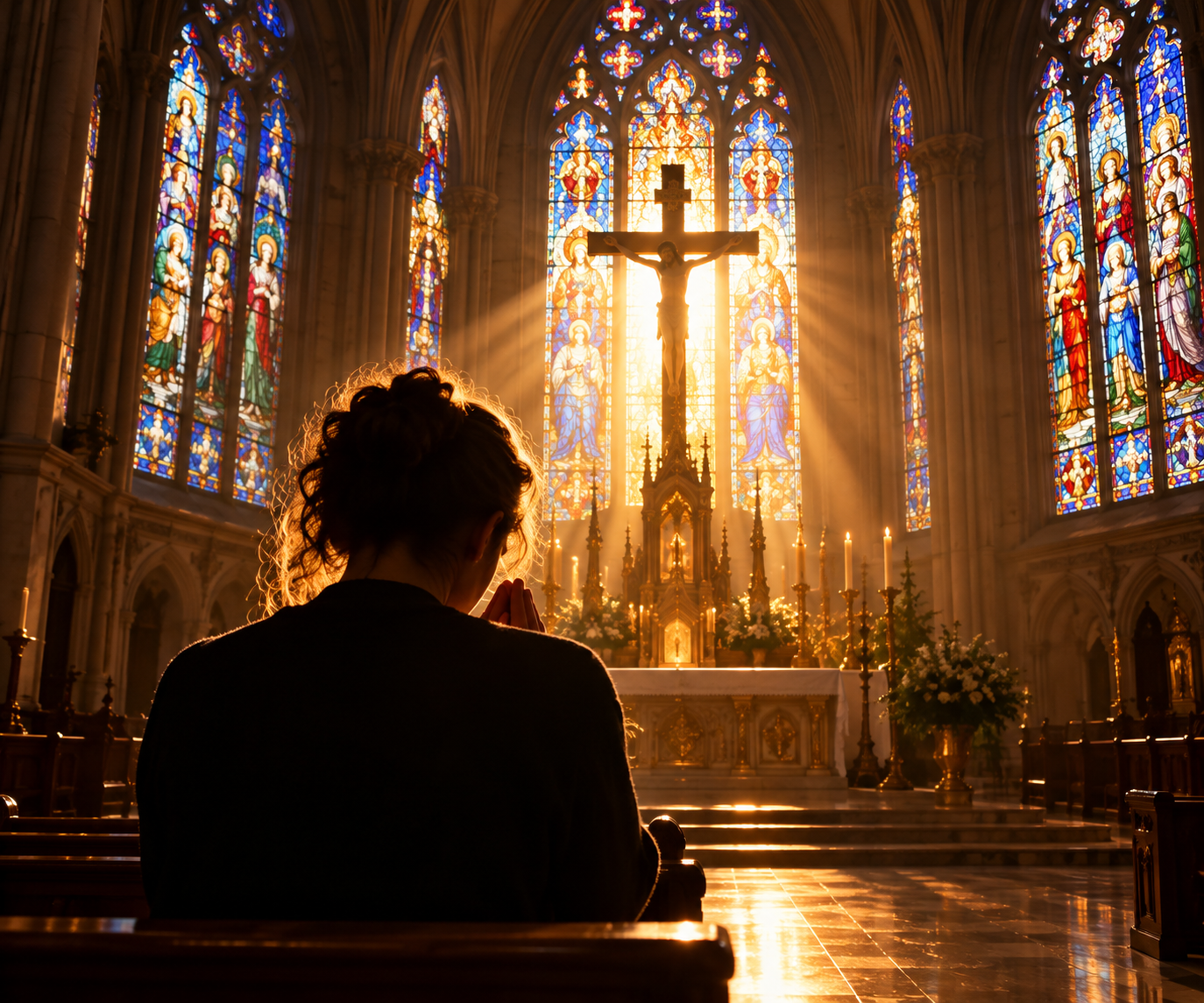
There is a word in the Our Father that I have always loved.
Hallowed.
Whenever I pray “Hallowed be Thy Name,” I find myself lingering over that one word. Sometimes I touch it on the page and repeat it silently. It echoes within me.
Perhaps it is the beauty of the word, or the reverence it awakens. But there is another reason it has stayed with me.
I am dyslexic.
For me, words do not always arrive as neatly as they appear on a page. Sometimes I understand a word perfectly in my mind, yet pronounce it differently.
Hallowed can become hollow.
One speaks of holiness. The other speaks of emptiness.
That small difference has led me to reflect on what we mean when we pray.
The Meaning Behind the Word
When we say “Hallowed be Thy Name,” we are not asking God to become holy. God is already holy. We are asking that His name be recognized, revered, and honoured as holy.
And perhaps we are asking something of ourselves, too: that God’s love might become visible in our ordinary lives, in the words we speak, the choices we make, and the way we treat one another.
We can pronounce every word of a prayer correctly and still hurry past its meaning. We can also stumble over a word and pray it with our whole heart.
I may sometimes say hollow when I mean hallowed.
But I know what I mean.
And I trust that God knows, too.
Prayer is not a language examination. It is a relationship.
An Ancient Prayer, a Familiar Meaning
I have also come to love praying the Our Father in the Aramaic-language Syriac tradition:
Abwoon d’bashmaya.
Nethqadash shmakh.
Our Father in heaven.
May Your name be held holy.
The Gospels preserve the Lord’s Prayer in Greek, and the Syriac Peshitta gives us an ancient Christian rendering in a related language tradition. We cannot say these are precisely the sounds Jesus spoke, but they carry the same essential petition.
For me, these unfamiliar sounds bring a familiar meaning into focus. I am no longer caught between hallowed and hollow. I can simply dwell in the prayer.
Sometimes, as I pray, other words arise quietly in my mind.
Echoing.
Boundless.
They are not changes to the Our Father. They are ways its meaning continues to unfold within me.
I experience something similar after receiving Communion, when I silently affirm Saint Paul’s words: “It is no longer I who live, but Christ who lives in me” (Galatians 2:20).
It is an inner attestation—a quiet affirmation of what I believe, not merely words recalled from memory.
The Words We Return To
This brings me back to the question I often carry into ordinary life:
Where is God—and who are we becoming?
Perhaps God meets us not only in extraordinary experiences but also in the prayers we have said a thousand times. In a word that catches our attention. In the silence after Communion. In a moment when pronunciation falters, yet understanding remains.
The Our Father has not changed.
But I am not the same person who first learned to recite it.
Sometimes prayer is not about finding more words to say. It is about discovering more meaning in the words we already know.
I still linger over hallowed.
I may not always pronounce it perfectly.
But the words may falter, and their meaning remains.
Hallowed be Thy Name.
Nethqadash shmakh.
Amen.



Leave a Reply