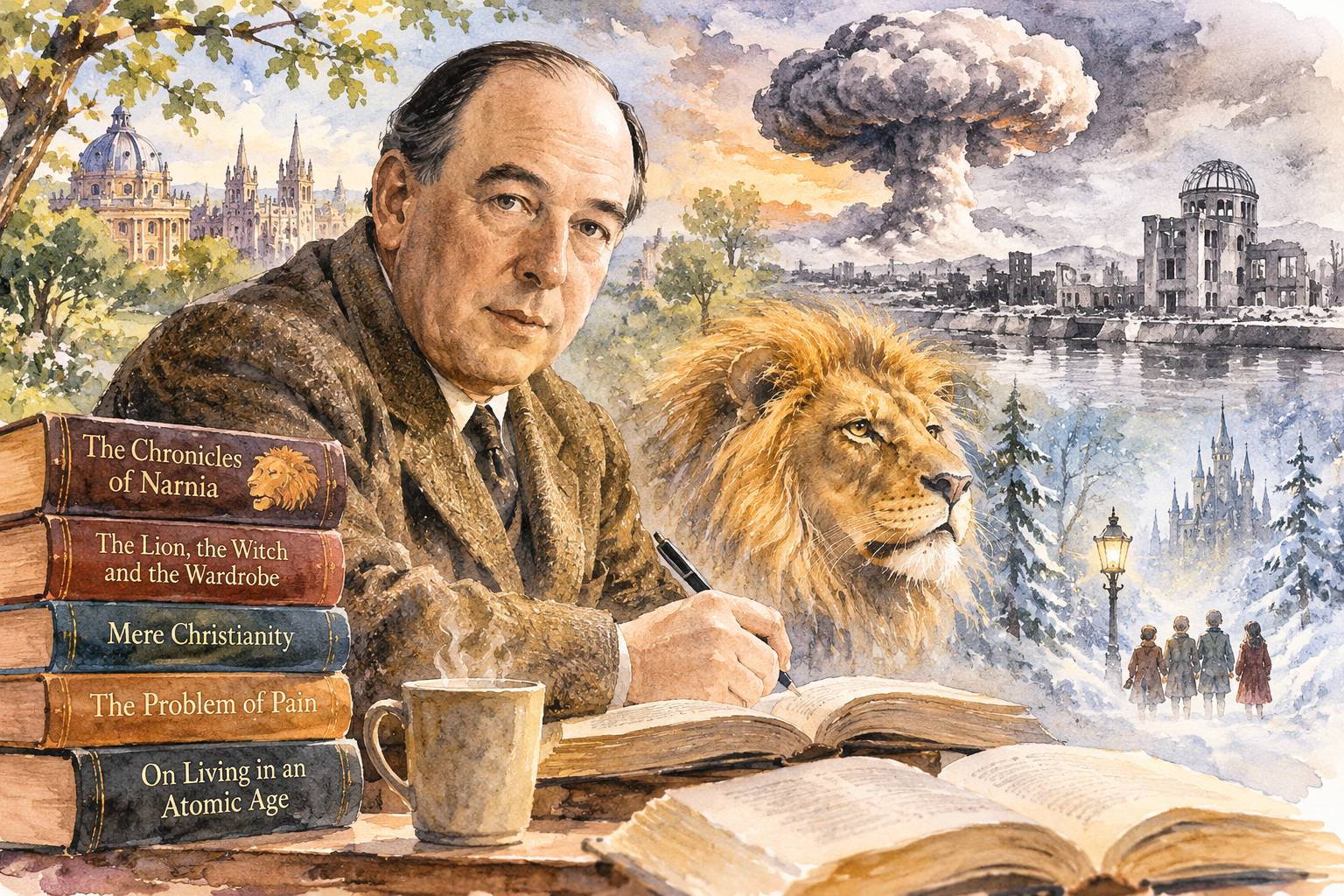
An inquiry into historical memory, uncertainty, Christian wisdom, and the human condition
We open our phones and begin scrolling.
One report warns of another approaching war. Another raises questions about artificial intelligence. We encounter stories of violence, environmental disasters, political unrest, and predictions of a world moving toward catastrophe. Some concerns are justified; others are speculative. Yet when they arrive together, it becomes difficult to distinguish an immediate danger from a possible future.
I began wondering whether the fears confronting us today are entirely new, or whether they reveal something familiar about the human condition. That question led me to C. S. Lewis’s 1948 essay “On Living in an Atomic Age.” Lewis argued that the atomic bomb changed the nature of danger but did not introduce mortality into human existence. His observation is worth examining, yet it raises a difficulty: if we have always lived with uncertainty, does that knowledge help us respond wisely to contemporary dangers—or risk making us underestimate threats that really are new?
A WORLD CHANGED BY THE ATOMIC BOMB
On August 6, 1945, the United States dropped an atomic bomb on Hiroshima. Three days later, another bomb struck Nagasaki. The devastation was immense, with deaths, injuries, radiation exposure, and lasting consequences for survivors. These were human catastrophes, not merely theoretical demonstrations of technology. [1]
By 1948, the world was entering the early Cold War. Lewis had lived through both world wars and served in the First. He wrote amid genuine uncertainty about international security and the future of civilization.
His essay begins: “In one way we think a great deal too much of the atomic bomb.” [2] He reminded readers that previous generations had lived through epidemics, invasions, warfare, and other threats. His point was not that nuclear weapons were harmless, but that humanity had never enjoyed complete security.
Yet individual mortality and the capacity to destroy entire populations are not the same moral question. The threat of collective destruction demands attention to human agency and responsibility.
WHAT LEWIS WAS ASKING
In his 1939 sermon “Learning in War-Time,” delivered shortly after Britain entered the Second World War, Lewis asked whether intellectual pursuits remained worthwhile during war. [3] If learning and creative work must wait until all danger disappears, much of human civilization could never develop.
The same question underlies his atomic-age essay: how should we live when the future cannot be guaranteed? Lewis encouraged ordinary duties—work, prayer, learning, relationships, music, and care for others—not because danger was unreal, but because anticipated catastrophe should not consume the present.
His argument is a moral and spiritual response to uncertainty, not a political solution to nuclear conflict.
WHAT EVERY GENERATION INHERITS
We inherit the knowledge of earlier generations through education, literature, testimony, historical research, and religious traditions. But possessing information does not automatically give us understanding. We can learn from events we have not experienced firsthand; the challenge is transforming that knowledge into judgment.
Ecclesiastes observes: “What has been, that will be; what has been done, that will be done. Nothing is new under the sun!” (Ecclesiastes 1:9, NABRE). [4] Read in context, this is not a denial of historical or technological change. Qoheleth examines recurring patterns of human striving and the limits of achievement. The chapter also warns that increased knowledge can bring sorrow (Ecclesiastes 1:18).
Our technologies and institutions change, yet mortality, uncertainty, power, and the search for meaning remain recognizable. Access to more information does not necessarily produce greater wisdom.
FEAR IN AN AGE OF CONTINUOUS INFORMATION
Lewis’s generation encountered danger through newspapers, radio, correspondence, and public discussion. Today, news and speculation from different countries and circumstances can appear together in a continuously updating feed. The presentation itself can make disconnected events feel like one uninterrupted crisis.
Canadian media theorist Marshall McLuhan offered a useful way of understanding the relationship between communication and experience. In Understanding Media: The Extensions of Man (1964), he introduced his famous proposition, “the medium is the message.” [5] His argument was that the form and social effects of a medium matter beyond the particular information it carries. A newspaper, radio broadcast, and digital feed may report the same event, but each creates different patterns of attention and experience. McLuhan invites us to consider not only what information tells us, but how the means of receiving it may shape our understanding.
Contemporary research offers a more specific empirical question. A study by Milli and colleagues examined engagement-based ranking on Twitter and reported amplification of emotionally charged and politically divisive content compared with a chronological feed. [6] That finding concerns a particular system and setting; it does not establish that all platforms operate alike or that social media inevitably makes people fearful.
Digital communication has also expanded access to knowledge, public awareness, and human connection. The challenge is to distinguish information that helps us understand and act from repeated exposure that leaves us anticipating catastrophe without greater clarity.
WHERE LEWIS NEEDS QUALIFICATION
I agree with Lewis that fear should not consume human life. But the inevitability of death does not make every threat morally equivalent. Some dangers can be reduced through knowledge, cooperation, ethical judgment, and collective action.
Fear itself is not always destructive. It can alert us to danger, motivate preparation, and awaken concern for vulnerable people. The distinction may be between fear that calls us to responsibility and fear that overwhelms our capacity to exercise it.
Lewis reminds us not to surrender the present to imagined futures. We must hold that insight alongside our duty to prevent avoidable suffering. We need perspective and action.
FROM MORTALITY TO WISDOM: SCRIPTURAL REFLECTION
Psalm 90 contrasts God’s eternity with the brevity of human life. It is not simply resignation before death; its prayer asks: “Teach us to count our days aright, that we may gain wisdom of heart” (Psalm 90:12, NABRE). [7] The psalm continues with petitions for mercy, joy, and the blessing of human work. Recognizing mortality becomes a call to wisdom and meaningful action.
In Matthew’s Sermon on the Mount, Jesus says: “Do not worry about tomorrow; tomorrow will take care of itself. Sufficient for a day is its own evil” (Matthew 6:34, NABRE). [8] Within Matthew 6:25–34, this is a teaching about providence and the priorities governing life—not a prohibition on planning or caring for material needs. Matthew 6:33 places the kingdom of God and righteousness at the center.
These texts offer related but distinct insights. Ecclesiastes examines the limits of human knowledge and striving; Psalm 90 turns awareness of mortality toward wisdom; Matthew asks us to order anxiety, trust, and responsibility rightly. None should be treated as though it anticipated the specific technologies of our era.
RETURNING TO THE SOURCE
I could have accepted Lewis’s observation as reassuring advice and left it there. Instead, I wanted to understand when he wrote, what he was responding to, and where his reasoning remains persuasive or requires qualification.
The same care matters with Scripture. A verse may resonate with our experience, but reading its literary and theological context prevents us from reducing it to a convenient slogan.
Returning to original sources does not mean accepting every conclusion. It means examining what was actually written, why, and how it may illuminate our circumstances.
THE QUESTIONS WE CARRY FORWARD
The world Lewis knew has changed. Our means of communicating, creating, and exercising power have changed, and some dangers have acquired genuinely new forms. Yet uncertainty has not disappeared.
We cannot simply borrow the answers of the past. We must examine them, learn from them, and consider how they apply to the responsibilities of our own generation.
Lewis offers one important insight: the possibility of catastrophe should not prevent us from living meaningfully today. Scripture asks whether recognizing our limits can deepen wisdom, trust, and responsibility. McLuhan adds a question about the media through which we encounter danger.
When we encounter the fears of our own age, are we responding only to the dangers before us, or are we also revealing something enduring about the human condition?
Perhaps understanding the difference is part of learning how to live wisely in the present.
REFERENCES AND SOURCE NOTES
[1] International Committee of the Red Cross. (2013). The effects of nuclear weapons on human health: Information note no. 1. https://www.icrc.org/en/doc/assets/files/2013/4132-1-nuclear-weapons-human-health-2013.pdf
[2] Lewis, C. S. (1948). On Living in an Atomic Age. Reprinted in W. Hooper (Ed.), Present Concerns: Essays by C. S. Lewis (1986, pp. 73–80). Harcourt Brace Jovanovich. https://gwern.net/doc/philosophy/ethics/1948-lewis.pdf
[3] Lewis, C. S. (1939, October 22). Learning in War-Time. Sermon at University Church of St. Mary the Virgin, Oxford; later collected in The Weight of Glory and Other Addresses. https://www.cslewis.com/learning-in-war-time/
[4] United States Conference of Catholic Bishops. New American Bible, Revised Edition. Ecclesiastes 1:1–18. https://bible.usccb.org/bible/ecclesiastes/1
[5] McLuhan, M. (1964). Understanding Media: The Extensions of Man. McGraw-Hill. Chapter 1, “The Medium Is the Message.”
[6] Milli, S., et al. (2025). Engagement, user satisfaction, and the amplification of divisive content on social media. PNAS Nexus, 4(3), pgaf062. https://doi.org/10.1093/pnasnexus/pgaf062
[7] United States Conference of Catholic Bishops. New American Bible, Revised Edition. Psalm 90. https://bible.usccb.org/bible/psalms/90
[8] United States Conference of Catholic Bishops. New American Bible, Revised Edition. Matthew 6. https://bible.usccb.org/bible/matthew/6
Author’s note: This article is a personal intellectual and theological inquiry. The interpretations and connections are the author’s own. Sources are provided so readers may examine the original texts and reach their own considered conclusions.





Leave a Reply