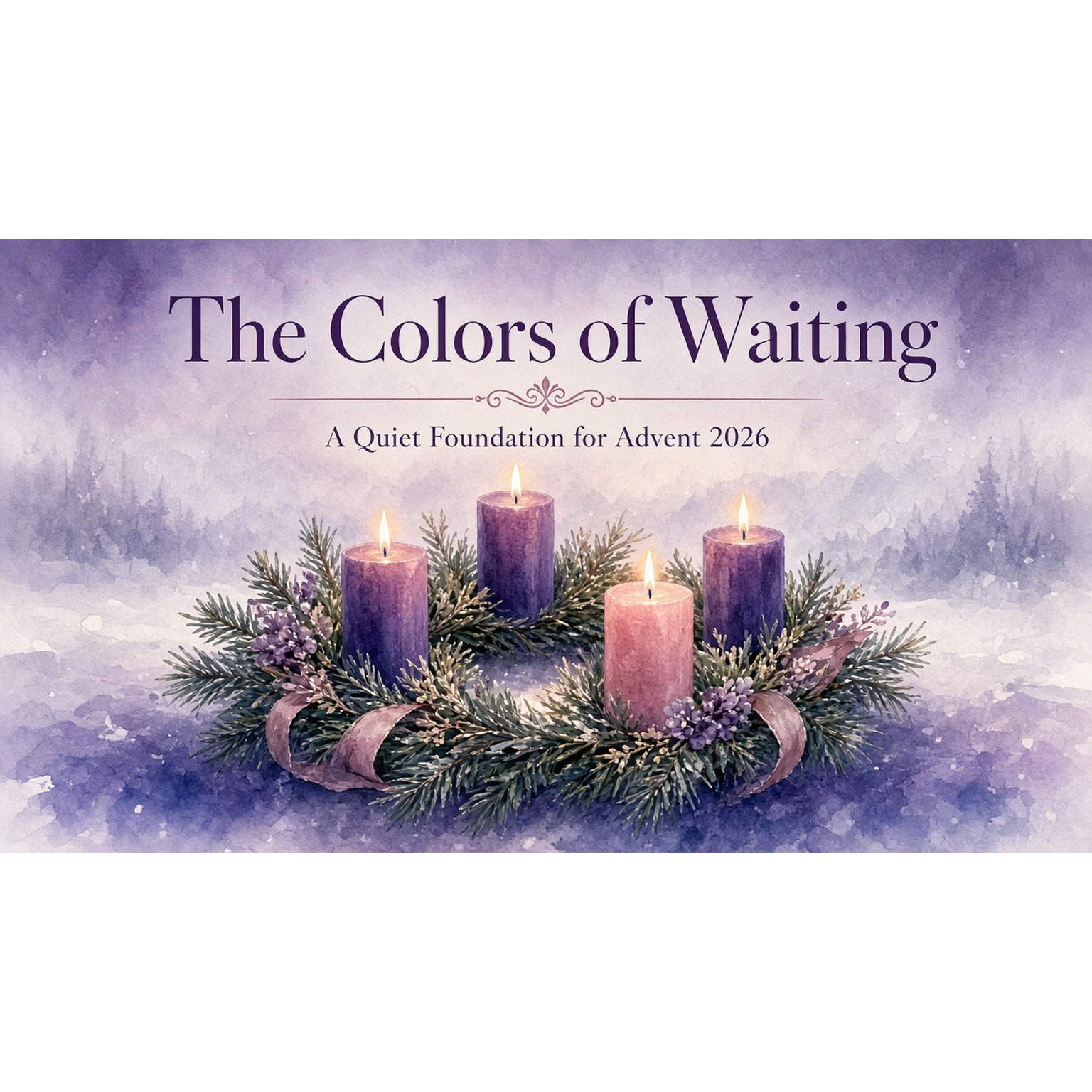
Tomorrow the Church turns a page. On Sunday, November 29, we step into Advent and into a new liturgical year. The violet vestments appear, the wreath is set on the table, and the first candle waits to be lit. Even if we have walked this season for decades, it is good to pause the day before and remember what the colors themselves are quietly teaching us.
Violet is the principal color of Advent. It is the color of preparation and of expectant waiting. It carries a note of royalty, because we are awaiting a King. It also carries a gentle invitation to make room in the heart. Unlike the deeper austerity of Lent, Advent’s violet is more reflective than severe. The Alleluia remains. We are not asked to empty ourselves in the same way; we are asked to clear a little space so that joy may enter. The color reminds us that waiting can itself be a form of worship when it is done with open hands.
On the Third Sunday—Gaudete Sunday, December 13—rose appears. The word Gaudete means “Rejoice.” The rose vestments and the single rose candle on the wreath are a deliberate interruption of violet. They announce that the Lord’s coming is near and that joy is already breaking through the waiting. It is the Church’s way of saying, mid-season, that we need not wait until Christmas morning to let a measure of gladness rise.
When Christmas itself arrives, the color shifts again. White or gold becomes the language of light, of joy fully present, of the Incarnation. The long violet days have led us to this brightness. The Word has become flesh and dwelt among us.
Between these colors stands the Advent wreath. Traditionally it holds three violet candles and one rose candle. Some families add a white Christ candle at the center, lit on Christmas Eve or Christmas Day. The evergreen circle speaks of everlasting life. Each week we light one more candle, and the growing circle of flame reminds us that darkness is already yielding. The light does not wait until the end to appear; it increases as we move toward the feast.
Tomorrow the first violet candle will be lit in churches and homes. Tonight, or sometime on this quiet Saturday, we can simply notice the colors that are about to surround us. We can set the wreath in place if we have one. We can open a little space in the day for the waiting that is about to begin. Advent does not ask us to manufacture a feeling. It asks us to let the colors do their quiet work—violet teaching us to prepare, rose reminding us to rejoice, white waiting to reveal the Light of the World.
May the first flame find us ready.
A Simple Guide to Advent Symbols
(for anyone walking the season, whether for the first or the fiftieth time)
Advent is the Church’s quiet season of waiting. The symbols we use are not complicated. They are gentle teachers that help ordinary people like us prepare our hearts.
The Advent Wreath
The wreath is a circle of evergreen with four candles.
- The circle has no beginning and no end. It reminds us that God’s love is everlasting.
- The evergreen stays green even in winter. It speaks of life that does not die and of hope that lasts.
- Each week we light one more candle. The growing light shows that darkness is already giving way.
The Colors
- Violet (the three ordinary candles) is the color of waiting and preparation. It is quieter than the purple of Lent. We are not mainly doing penance; we are making room.
- Rose appears on the Third Sunday. It is a deliberate note of joy. The wait is more than half over.
- White or gold arrives at Christmas. Waiting turns into presence. The Light has come.
The Four Candles
- First Sunday – Hope — We remember the old promises. Hope is not wishful thinking. It is trust that God keeps His word.
- Second Sunday – Peace — John the Baptist calls us to prepare the way. Peace grows when we clear the crooked places in our own hearts.
- Third Sunday – Joy (the rose candle) — Gaudete means “Rejoice.” Joy is already leaking into the season. We do not have to wait until Christmas morning to begin.
- Fourth Sunday – Love — Love is why God comes. The final violet candle points to the love that will soon be fully visible in the Child.
A Few Other Simple Symbols
- An empty manger reminds us to make space.
- Light in the dark is the central picture of the whole season.
- The O Antiphons (the last days before Christmas) give Jesus different names—Wisdom, Key of David, Emmanuel—so we can turn them over in prayer.
None of these symbols ask us to be experts. They simply invite us to notice. Light one candle. Let the evergreen remind you that life continues. Let the rose candle give you permission to rejoice a little early. And when the white candle is lit, remember that the One we waited for is already here.
May the symbols be gentle companions for your waiting.



Leave a Reply