
Growing older does not mean we must stop becoming.
Today my boss asked, “Why don’t you retire and go enjoy yourself?”
I looked at her, puzzled. Enjoy myself? But I am enjoying myself.
She suggested visiting hospitals, talking with seniors, or spending time with people my own age. There is nothing wrong with those things. They may be a source of great happiness for others. But why should someone else’s idea of happiness define mine? Why should age dictate the form that joy must take?
The Life I Already Enjoy
I work three days a week as an early childhood educator. The work keeps me connected to children, colleagues, and the complexities of human behaviour. Having studied anthropology, sociology, and art education, I cannot help observing. An ordinary conversation becomes an essay; a child’s discovery awakens a memory; a workplace disagreement prompts questions about pride, kindness, and discernment. I am not looking for material. I am living my life, and the questions emerge.
My intellectual life is another source of joy. For years it lay relatively dormant. I had studied, researched, painted, photographed, and made installations. Then marriage, family, and work filled the days. Those responsibilities mattered, but the part of me that delighted in philosophical inquiry grew quieter.
About ten years ago, I began writing again. Slowly, something awakened. Old ideas resurfaced, memories returned, and one question led to another. Today I write faith-based books, children’s stories shaped by Chinese culture and family memory, essays on the human condition, and lyrics for faith-based music. I investigate technology, ethics, art, and theology. I do not do these things because I have all the answers. I do them because I love discovering how much I still have to learn.
As Proverbs 1:5 teaches, the wise continue to listen and increase in learning. Wisdom is not a possession we acquire once and keep untouched. It asks us to remain receptive.
The Joy of Questioning
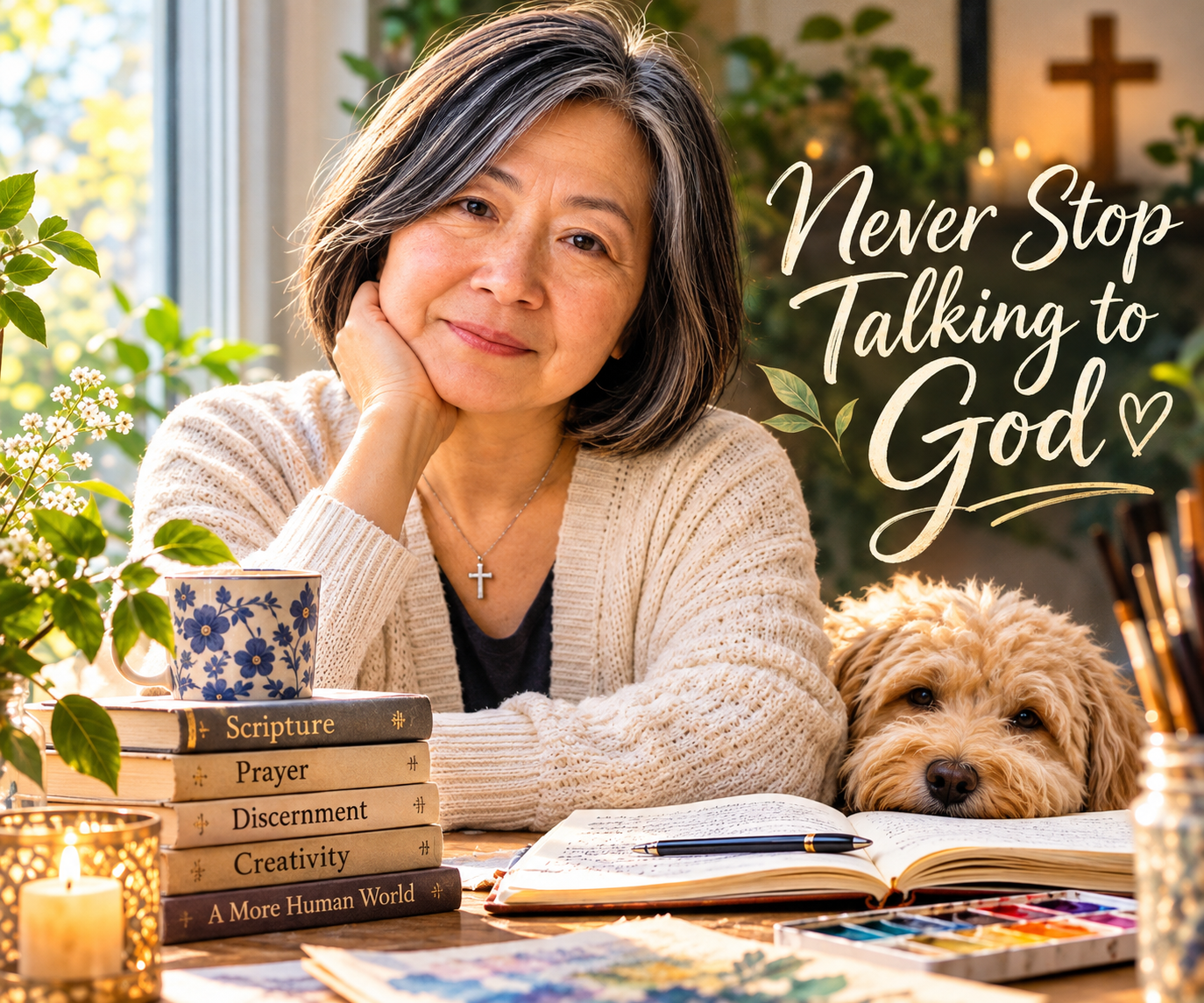
Recently I saw an illustration of myself sitting quietly with my dog, surrounded by books, Scripture, and the thinkers who have shaped my spiritual life. I smiled. That is me enjoying life.
From the outside I may appear to be doing very little. Within my mind, however, I may be travelling through centuries of thought, returning to a biblical passage, or asking how a small incident reveals something about the human condition. My thoughts can seem to meander, but there is a logic to them. There is a question underneath, a thread I am following.
I enjoy contemplation. Stillness is not inactivity, and solitude is not necessarily loneliness.
The Age of Reason
One of my favourite verses is 1 Corinthians 13:11: “When I was a child, I spoke like a child, I thought like a child, I reasoned like a child; when I became an adult, I put an end to childish ways.” (NRSV)
Paul writes within his great meditation on love. He is not merely praising intellectual achievement or equating age with wisdom. He is speaking of maturity, of moving beyond partial ways of knowing. The following verses remind us that our knowledge remains incomplete.
This is what the passage means to me as I grow older. I have lived long enough to recognize that things I once considered certain were often more complicated than I understood. Experience has taught me to question. Faith has taught me to listen. Time has taught me humility.
Perhaps this is my age of reason: not the age when I know everything, but the age when I can freely acknowledge what I do not know. Proverbs 18:15 reminds us that discerning hearts seek knowledge. I do not want to stop seeking simply because society expects me to slow down.
Faith, Reason, and Becoming
For me, faith and reason are companions. Reason encourages investigation; faith asks what knowledge means for the way I live. Am I becoming more patient, compassionate, responsible, and discerning? Am I learning to recognize my own assumptions?
Paul’s warning in 1 Corinthians 8:1 is essential: “Knowledge puffs up, but love builds up.” (NRSV) I know that I can speak too quickly or grow impatient with people who see things differently. I am still learning when to speak and when to be silent. The purpose of knowledge is not to place myself above others. It is to help me live more faithfully.
The Pendulum and the Compass
The world keeps changing. Technologies develop, social expectations shift, and old habits are challenged. The pendulum swings. But what matters is the compass at the centre.
For me that compass is Christ. It calls me to judgment, courage, discernment, and responsibility, and to examine my prejudices before deciding how to respond. Progress is not automatically wisdom. Nor is preserving the familiar automatically virtue.
Micah 6:8 calls us to justice, kindness, and humility before God. That is the direction in which I hope my compass points. My books, music, children’s stories, and essays are different ways of exploring that calling: preserving memories, encouraging love, questioning assumptions, and sharing grace.
Retirement Is Not the End of Becoming
One day I may leave paid employment. But retiring from a job is not retiring from curiosity, learning, faith, or creation.
Psalm 92:14 describes the righteous as still bearing fruit in old age. I love that image. The fruit of later years may be different from that of youth, but it can be rich with experience, gratitude, and understanding.
I am no longer pursuing a degree or trying to establish a career. I can investigate a question because it interests me. I can write because I have something to say. I can create because creating itself brings joy.
Perhaps instead of asking people when they will retire and enjoy themselves, we should ask what brings them joy and how they hope to continue living it.
For me, the answer is simple. I already am.
There are stories to tell, songs to write, memories to preserve, and questions to explore. I am grateful that the intellectual life I once thought dormant has awakened again. I am grateful for the people and experiences that keep it alive. And I am grateful that God continues to work within me.
I will continue to write, question, learn, and become.
Growing older does not mean we must stop becoming.
Scripture references: 1 Corinthians 13:11; 1 Corinthians 8:1; Proverbs 1:5; Proverbs 18:15; Micah 6:8; Psalm 92:14. Biblical quotations identified as NRSV; other passages paraphrased.



Leave a Reply