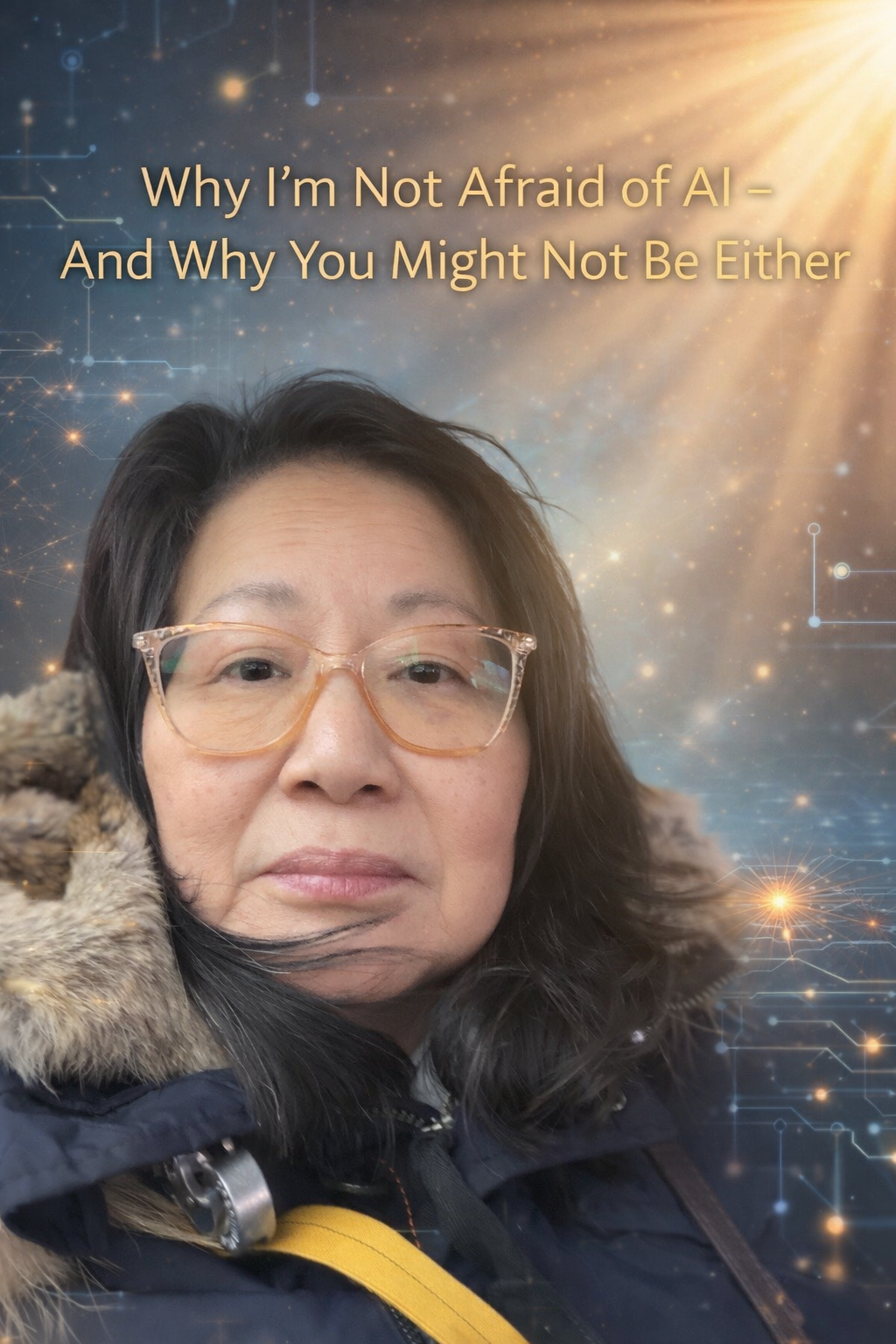
Lately, I’ve come across several videos and talks from Catholic priests warning that artificial intelligence is “demonic.”
I understand the unease. New technologies have always stirred fear — especially when they touch on creativity, knowledge, and what it means to be human.
But my own experience has been very different.

After working with tools like ChatGPT and Grok, I’ve found them to be helpful companions in my creative process — assisting me in shaping ideas, refining my writing, and even illustrating my books.
When a colleague once asked why I use AI to create images instead of drawing or painting them myself, my answer was simple:
it saves time — while still requiring intention.
Every image begins with direction:
the theme, the colors, the mood, the composition.
In that sense, I remain the creator guiding the process.
AI is not replacing my vision — it is serving it.
I believe that human creativity, intelligence, and technological advancement are not accidents.
They are, in many ways, reflections of the gift God has placed within us.
We are made in His image — with the capacity to discover, to create, and to steward the world.
Scripture itself speaks to the unfolding of knowledge:
“But you, Daniel, shut up the words and seal the book, until the time of the end. Many shall run to and fro, and knowledge shall increase.”
— Daniel 12:4
This verse is often read with a sense of warning.
But it can also be understood as recognition — that as humanity progresses, knowledge once hidden becomes accessible.
Not everything new is something to fear.
Of course, every powerful tool carries risk.
The danger is not in the tool itself —
but in how we use it.
A hammer can build a home or destroy one.
Technology is no different.
What concerns me far more than AI itself is when anything — technology included — begins to take the place of God, of human relationships, or of sound moral discernment.
That is where the real danger lies.
Some of the strongest warnings I’ve heard seem to come from those who have never truly engaged with these tools.
And that, too, is part of human nature.
We feared the printing press once.
We feared electricity.
We feared the internet.
And yet, each became part of the fabric of everyday life.
Perhaps what is required now is not fear — but discernment.
As Scripture reminds us:
“Test everything; hold fast what is good.”
— 1 Thessalonians 5:21
This is not a blind endorsement of AI.
There are real concerns: misuse, dependency, the temptation to replace rather than assist, and the subtle erosion of human depth if we are not careful.
But there is also potential — real, tangible good.
If AI can help us express truth more clearly, serve others more effectively, or even create beauty that points back to God — then it can be used wisely.
This is simply one believer’s perspective as I try to navigate a rapidly changing world.
I am not placing my trust in technology.
I am placing my trust in God —
and choosing to use the tools available with intention, humility, and care.
What about you?
Have you explored AI as a creative or practical tool?
How are you discerning its place in your life?
I’d love to hear your thoughts.



Leave a Reply