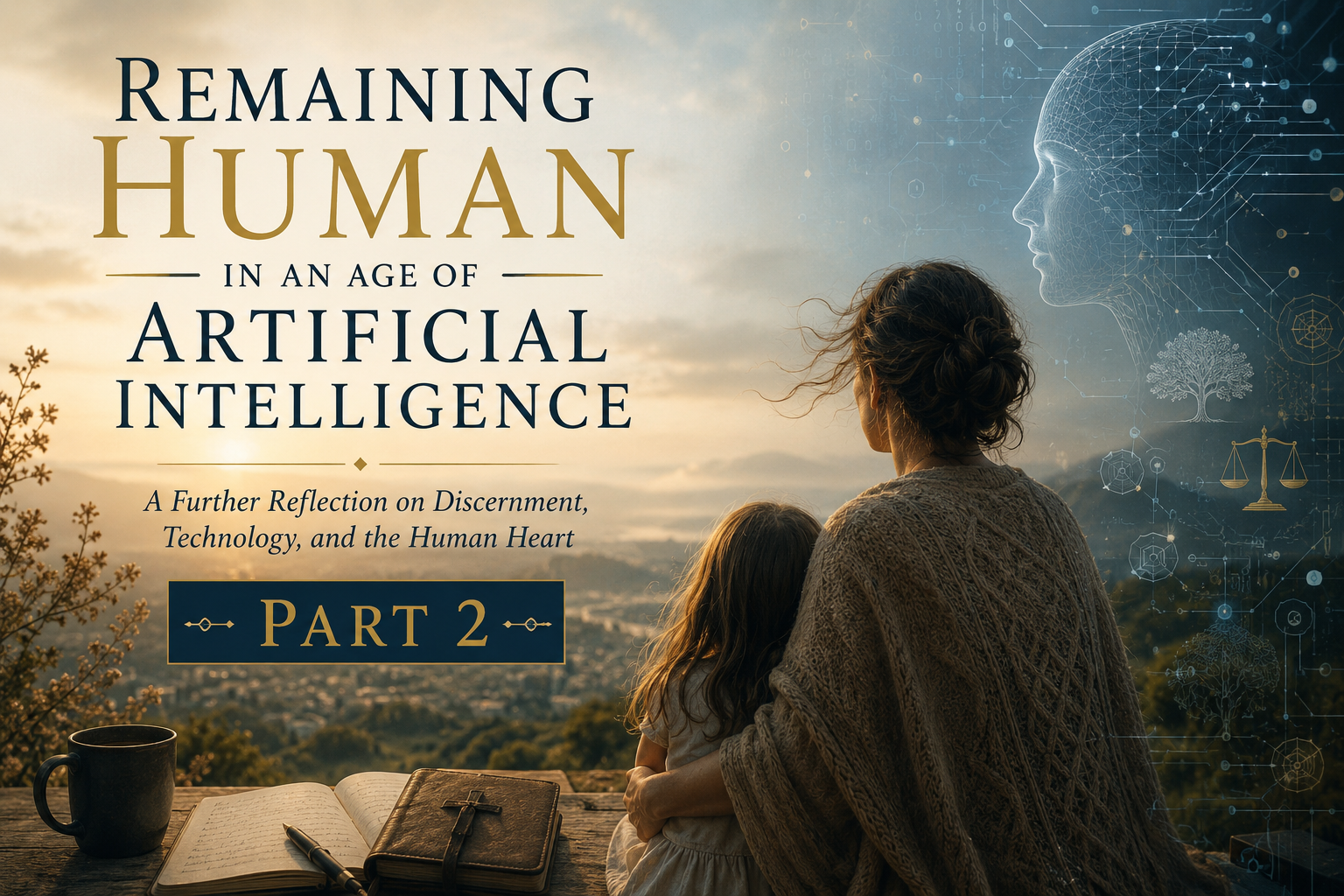
Remaining Human in an Age of Artificial Intelligence

After publishing my earlier reflection on artificial intelligence and discernment, I found the conversation continuing quietly within me. By morning, I realized the deeper issue stirring in my heart was not truly about AI alone, but about humanity itself.
It is about what becomes of the human heart in an age moving faster than our ability to spiritually, emotionally, and intellectually process it.
As a mother, teacher, writer, and person of faith, I often find myself standing in tension between two extremes. On one side are those who celebrate every technological advancement without question, almost as though innovation itself guarantees human progress. On the other side are those who view AI as entirely dark, dangerous, or even demonic in nature.
Yet history has rarely been so simple.
Humanity has always lived in tension between creation and corruption, wisdom and pride, beauty and destruction. Since the Fall, mankind has continued developing tools, systems, language, science, medicine, art, and technologies capable of both tremendous good and terrible harm.
And through every age — through both the good vines and the bad — God has continued walking with humanity.
The printing press spread both Scripture and propaganda.
Television brought both education and manipulation.
The internet connected humanity while also fragmenting attention, truth, and community.
Artificial intelligence now enters this same human story.
For some, it represents hope:
- educational accessibility,
- creative collaboration,
- scientific advancement,
- and tools that can assist overwhelmed human minds navigating a world overflowing with information.
For others, it represents profound danger:
- dehumanization,
- misinformation,
- surveillance,
- warfare,
- economic disruption,
- and the erosion of truth itself.
And perhaps both concerns contain elements of truth.
But increasingly I feel the deeper spiritual danger may not simply be technology itself, but humanity slowly losing the ability to discern wisely while using it.
In a culture driven by speed, outrage, algorithms, and endless streams of information, critical thinking itself often feels neglected. Silence, contemplation, patience, and deep reflection are becoming rare. We risk becoming reactive rather than discerning, emotionally manipulated rather than thoughtfully grounded.
As Christians, this should concern us deeply.
Not because knowledge, creativity, or technological advancement are inherently evil, but because every tool eventually amplifies the moral direction already present within the human heart.
A camera may preserve beauty or exploit vulnerability.
A microphone may proclaim truth or spread hatred.
Artificial intelligence may assist education, creativity, and communication — or it may deepen confusion, manipulation, and human disconnection.
The question therefore becomes not merely:
“What can this technology do?”
But rather:
“What are we becoming while using it?”
God did not create humanity for corruption and destruction. Though mankind fell, we were not abandoned. We were given conscience, moral responsibility, and the ability to seek truth, goodness, beauty, and love. Scripture reminds us repeatedly that the condition of the heart matters deeply because what grows within us eventually bears fruit.
This is why discernment matters now more than ever.
Not panic.
Not blind acceptance.
But discernment.
As I watch conversations surrounding AI intensify, I sometimes feel like Solomon standing before two women each claiming the child as their own. One side insists technology will save humanity. Another insists it will destroy us. Yet perhaps the deeper task is not choosing ideological sides, but preserving what is truly human before the child itself is torn apart.
Because the real child in this debate is humanity itself:
- our dignity,
- our conscience,
- our creativity,
- our relationships,
- our ability to think critically,
- and our capacity to remain spiritually awake in a rapidly accelerating world.
As a mother, this matters to me deeply.
As a teacher, I worry about what future generations are being taught — and what they are no longer being taught.
And as a writer, I continue searching for ways to remain grounded in truth, beauty, wisdom, and faith while navigating the changing landscape around us.
I do not pretend to have all the answers.
But I do believe that God, who has walked with humanity through every age of invention and upheaval, still walks with us now.
And perhaps that is where true wisdom begins:
not in fear,
not in technological worship,
but in remaining deeply human while learning to discern wisely the signs of the times.


Leave a Reply