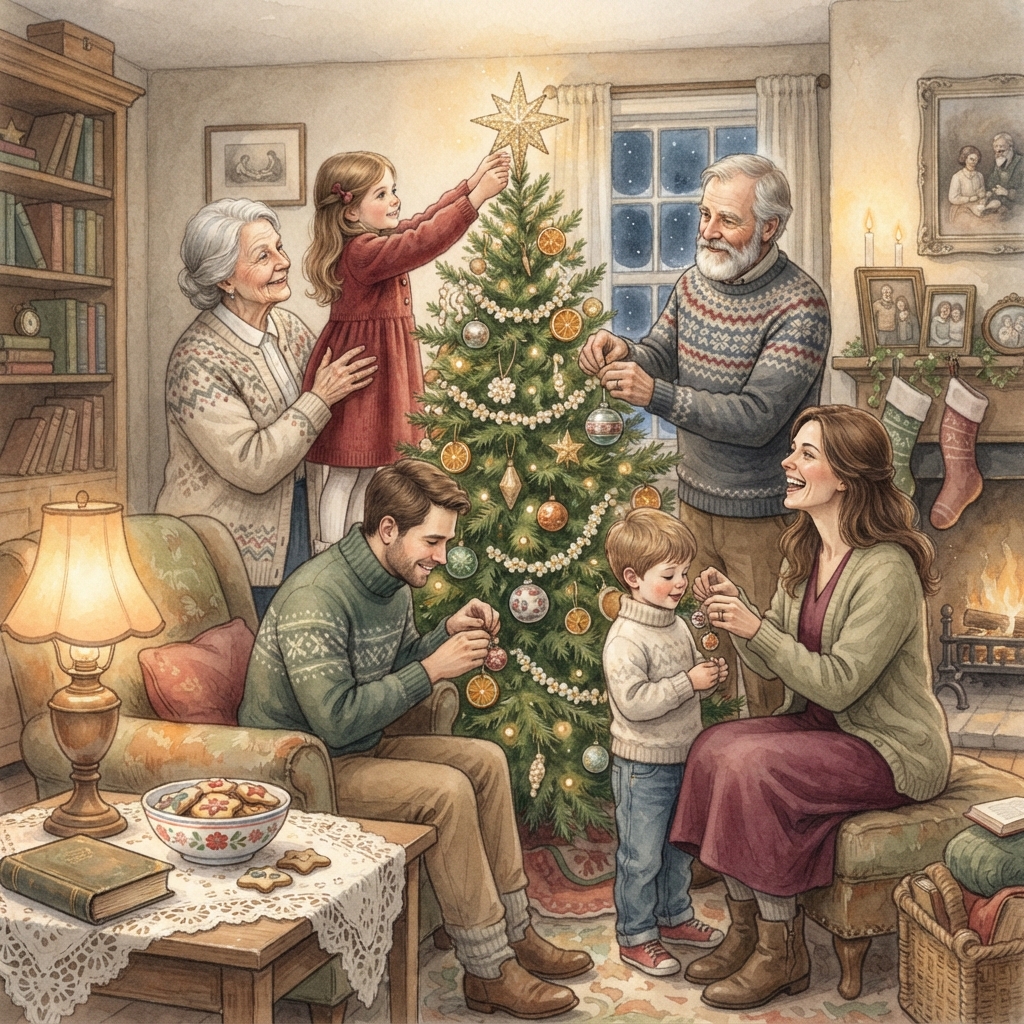
There is something about the holidays that stirs our memories.
Perhaps it is the familiar Christmas music, the decorations, or the smell of food coming from the kitchen. Perhaps it is the anticipation of gathering with family and friends, or remembering those who once gathered with us.
As I grow older, I find that Christmas brings me back to my childhood.
I remember my father opening our home to others during the Christmas season. There were people coming and going, food to share, conversations, laughter, and the warmth of being together.
I remember the church potlucks, the Christmas caroling, and the fellowship that was so much a part of our lives. We sang together, ate together, and shared in the simple pleasure of one another’s company.
As a child, I did not think much about the meaning of these gatherings. They were simply part of Christmas, part of growing up, part of the world I knew.
But looking back, I recognize something I could not have understood then.
My father was teaching me about love.
Not through elaborate explanations or grand gestures, but through the ordinary act of opening our home and welcoming others.
There was always room for another person.
And perhaps that is what I remember most.
Not the presents beneath the Christmas tree or the decorations that filled our home, but the people who gathered there and the sense of belonging that surrounded us.
A Christmas Aside: The Tree We Decorate
The custom of decorating Christmas trees became especially popular in German-speaking Europe. For Christians, the evergreen can symbolize enduring life and hope, while its lights recall Christ, the Light of the World (John 8:12). The star placed at its top reminds us of the star of Bethlehem (Matthew 2:1–12).
But perhaps one of the loveliest things about the Christmas tree is the simple act of decorating it together—another ordinary family moment in which memories are made and love is shared.
The Passing of Time
Christmas changes as we grow older.
The people who once filled our homes are not always there anymore. Some have died. Others have moved away. Children grow up, families change, and traditions that once seemed permanent gradually become memories.
There is a certain tenderness in remembering those earlier Christmases.
We may hear an old carol and suddenly find ourselves transported back to another time. A familiar melody can bring to mind a voice we have not heard in years, a face we have not seen, or a home that no longer exists as we remember it.
Sometimes what we miss is not Christmas itself, but the people with whom we once celebrated it.
And yet, these memories are not simply reminders of what we have lost.
They also remind us of what we have received.
The love that shaped our childhood does not necessarily disappear when the people who gave it to us are gone. It remains in the way we remember, in the values we carry, and sometimes in the way we learn to love others.
The Love That Came Near
For me, Christmas is inseparable from the birth of Jesus Christ.
The Gospel of John tells us:
“And the Word became flesh and lived among us.” — John 1:14
There is something extraordinary about those words.
God entered human history not through worldly power or grandeur, but through the vulnerability of a child.
Jesus was born into an ordinary human family, in circumstances far removed from the splendour we might associate with a king.
The Incarnation reminds us that God did not remain distant from the human condition. He came among us, entering a world of uncertainty, suffering, tenderness, and love.
And perhaps this is why the ordinary things we do for one another matter so deeply.
A meal shared. A door opened. A place made at the table.
These gestures do not compare with the mystery of the Incarnation, but they can become small expressions of the love Christ calls us to live.
When I think of my father’s hospitality now, I see it through a different lens.
He was not simply entertaining guests or observing a Christmas tradition.
He was living something of the faith he believed.
And I was watching.
Love Made Ordinary
It is curious how much we learn as children without realizing that we are learning.
We observe the adults around us. We notice how they treat people, how they respond to those in need, and whether their words are reflected in their actions.
My father never needed to sit me down and explain the theology of hospitality.
He simply opened the door.
Years later, I recognize that those ordinary Christmas gatherings were part of my earliest understanding of what Christian love could look like.
Love was being made ordinary.
Not diminished by its ordinariness, but made visible through it.
Today, my Christmas celebrations are different from those of my childhood. The years have passed, the family has changed, and many of the people I remember are no longer here.
But something remains.
When I hear the old Christmas carols, I remember the fellowship of our church community. When I think of the Christmas table, I remember my father’s generosity. And when I reflect on the birth of Christ, I recognize more deeply the invitation to carry that love into the world.
Perhaps this is one of the quiet gifts of growing older.
We begin to understand the meaning of things we once took for granted.
We recognize that the ordinary moments of our lives were often the very places where grace was at work.
The Tables We Carry Within Us
I sometimes wonder what people remember most about the Christmases of their childhood.
Is it the presents? The decorations? The anticipation of Christmas morning?
Or is it something quieter?
The sound of familiar voices. The warmth of a crowded room. The knowledge that someone had prepared a place for us.
For me, it is the memory of my father’s open door and the people who gathered around our table.
Those Christmases are long past, but their meaning continues to unfold.
They remind me that hospitality is more than entertaining. It is an act of welcome. It tells another person that their presence matters.
And perhaps that is something we can carry into every Christmas, regardless of how our circumstances have changed.
We may no longer have the same home, the same traditions, or the same people gathered around us.
But we can still offer the gift of welcome.
We can still make room.
As Christmas approaches, I find myself giving thanks not only for the memories of years gone by, but for the love that made those memories possible.
I think of my father, the church gatherings, the carols, and the tables filled with people.
And I think of the child I once was, watching it all without knowing how deeply those moments would shape her life.
Grace was already there.
And perhaps that is what I have come to understand about Christmas.
The tables of our childhood may be gone, but the love we encountered around them can continue to find a place in the world through us.
“Let mutual love continue. Do not neglect hospitality, for through it some have unknowingly entertained angels.” — Hebrews 13:1–2



Leave a Reply