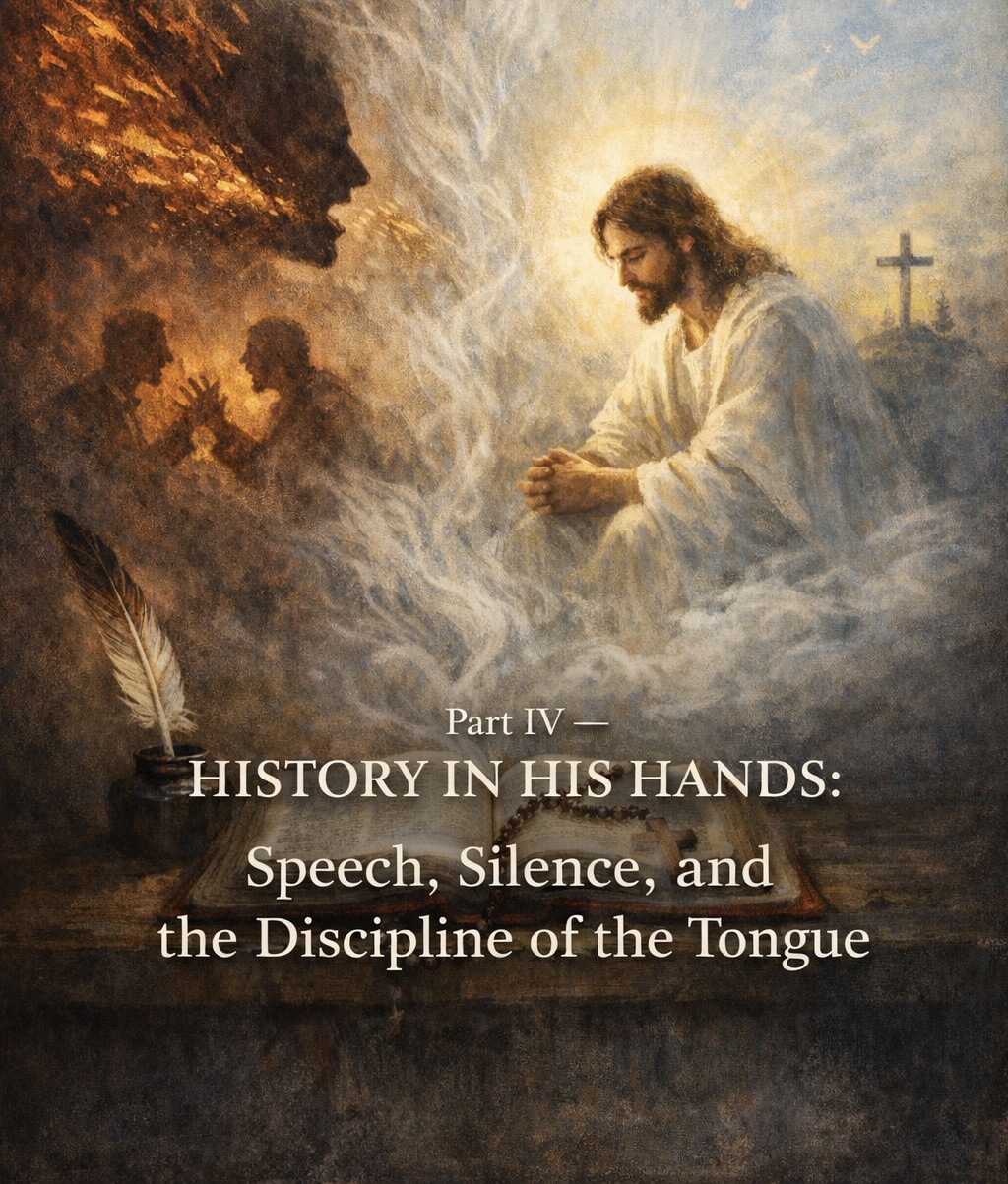
If history is in His hands be, then so too are our words.
In Parts I–III, we reflected on intellectual discernment, cultural currents, and Christ at the center of time. But discernment does not remain abstract. It enters our homes, our workplaces, our classrooms — and perhaps most dangerously — our speech.
Ludwig Wittgenstein once noted that language carries force; it does not merely describe reality but shapes it. Words that proceed from our mouths are not neutral. They hold power. And when misdirected, they can be weaponized — ammunition loaded not with bullets, but with accusation, tone, and assumption.
Scripture knew this long before philosophy articulated it:
“Death and life are in the power of the tongue.” — Proverbs 18:21
“The tongue is a small member, yet it boasts of great things.” — James 3:5
Recently, I encountered this truth in a deeply personal way.
As a teacher, due to a misunderstanding — and yes, my own oversight — a minor situation became the subject of a sharply worded letter sent to my director. I had been honest with the parents. I explained that I had not received the child’s water bottle and assumed it had not been sent, as the child had only attended for a short time. Unbeknownst to me, the bottles had remained in the cubby over the weekend.
An oversight.
Nothing more.
Yet the tone of the letter transformed a small human mistake into something dramatic and accusatory. I had already apologized. What struck me most was not correction — but the spirit in which it was delivered. It felt as though rage had been poured into sentences, words sharpened into blades.
Honesty, in that moment, seemed to cost me more than silence would have.
And it hurt — not because I resist accountability, but because unjust accusation pierces at the core of integrity. As someone who strives to walk truthfully before God, I do not lie. Nor do I evade responsibility. To be demeaned in writing for what was an honest misunderstanding revealed something larger than one difficult exchange.
It revealed the spirit of our age.
We live in a time of immediate reaction. Immediate outrage. Thirty-second judgments. A culture trained in dramatization and emotional escalation. Nuance is lost. Patience is rare. Empathy is optional.
This is why Lent is so necessary.
Pope Leo XIV recently reminded the faithful that conversion of heart includes conversion of speech — that fasting is not only from food, but from harmful words, sarcasm, rash judgment, and verbal aggression. To watch what we say is not weakness; it is spiritual discipline. It is charity under restraint.
Christ Himself stood silent before accusation (Matthew 27:12–14). He did not retaliate with divine argument. He did not weaponize truth. He entrusted Himself to the Father.
What strength that silence required.
The question for us becomes: In an age of outrage, will we add to the noise — or will we become guardians of language?
The tongue can set a forest ablaze.
But it can also bless.
In moments like these, I am reminded that discernment is not only about analyzing history or culture. It is about governing the interior life so that wounded pride does not become wounded retaliation. It is about refusing to let another’s harshness determine the tone of our own spirit.
Perhaps this is Part IV of discernment:
Not only seeing clearly.
Not only understanding culture.
Not only anchoring ourselves in Christ.
But speaking as though every word will echo in eternity.
Because history may be in His hands —
but our words are in ours.
And Lent invites us to place even those back into Him.
A Closing Prayer
Lord Jesus,
Living Word,
spoken before time
and whispered still into restless hearts —
teach my tongue the language of heaven.
Where anger gathers at the edge of my lips,
breathe Your gentleness.
Where pride sharpens its defense,
lay upon it the hush of Your silence before Pilate.
Let me not return wound for wound,
nor accusation for accusation.
When I am misunderstood,
steady me in truth without bitterness.
When I am blamed,
root me in the quiet knowledge that You see.
Place a guard at the doorway of my mouth.
Sift my words through mercy
before they enter the world.
May my speech carry light, not flame.
May my silence speak trust, not resentment.
May every sentence I release
belong first to You.
You hold history in Your pierced hands.
Hold also my voice —
that nothing I say
would fall outside Your love.
Amen.
The One who guards our words now walks toward Jerusalem. Let us walk with Him.
God Bless 🙏💕

 Be Inspired!
Leave a comment