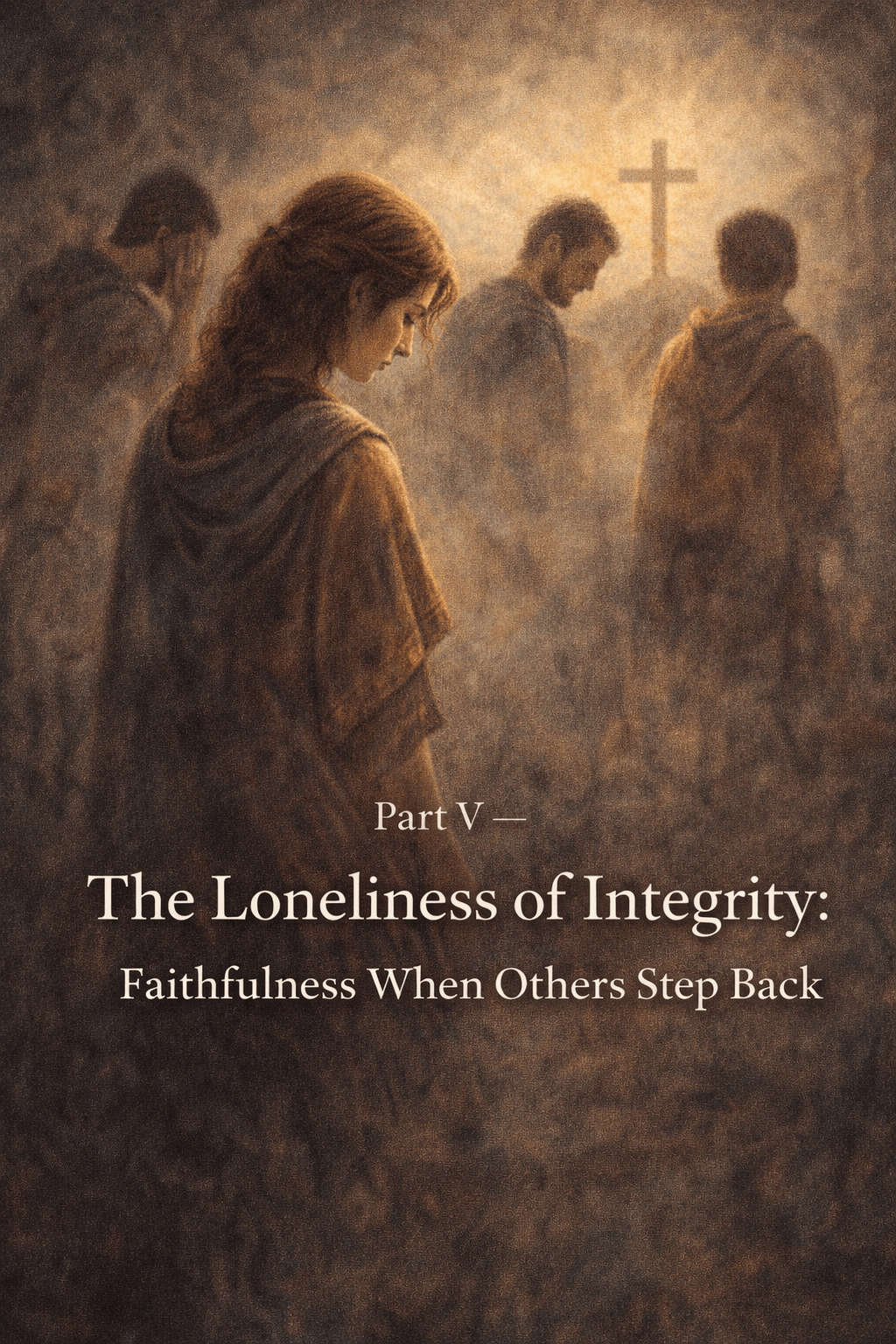
Standing in quiet faith, even when integrity feels lonely — Part V of “History in His Hands: Discernment, Culture, and Christ.”
There are moments in life when discernment costs something.
Not in theory.
Not in cultural critique.
But in relationships.
After the recent misunderstanding that led to a parent’s letter of complaint, our teaching team was called into the director’s office. I acknowledged my oversight openly. I did not hesitate. Responsibility, when it is mine, is not something I shrink from.
What I did not expect was the quiet retreat of those beside me.
Later I learned they were afraid — worried that if the parent complained further, their own positions might be threatened. And so silence felt safer than solidarity.
It was not hostility that hurt.
It was absence.
I left that meeting not angry, but saddened. For years, I have believed that being a team means standing together — especially when mistakes occur. I have never hesitated to absorb blame if it protected others. But in that room, I realized something sobering:
Fear often speaks louder than loyalty.
And then I thought of Gethsemane.
When Christ was arrested, “they all left Him and fled” (Mark 14:50). These were not strangers. They were friends. Men who had walked with Him for years. Yet fear overtook devotion.
Peter, bold and devoted, denied Him three times (Luke 22:54–62).
It was not hatred.
It was fear.
The Christian life does not shield us from this reality. In fact, it prepares us for it.
Integrity sometimes stands alone.
But here is the deeper spiritual question:
What do we do with the loneliness that follows?
The temptation is subtle. Not retaliation — but superiority. Not anger — but quiet judgment. “I would not have done that.”
Yet Lent teaches me to examine my own heart first. I do not know what I would do if my livelihood felt genuinely threatened. I do not know how courage would hold under greater pressure.
So this moment becomes less about their failure and more about my formation.
Christ did not shame the disciples after the Resurrection. He restored them.
He did not weaponize their abandonment.
He forgave it.
Perhaps integrity is not proven when others applaud it —
but when others retreat from it.
And perhaps the deeper call is this:
Stand in truth.
Refuse bitterness.
Leave vindication to God.
“Commit your way to the Lord; trust in Him, and He will act” (Psalm 37:5).
History is in His hands.
Reputation is in His hands.
Even workplace misunderstandings are in His hands.
To be a Christian is not to avoid disappointment in “the mores of man.” Scripture is brutally honest about human weakness. The Bible is not a story of flawless loyalty — it is a story of fragile people upheld by divine mercy.
And so I choose to let this experience refine rather than harden me.
To remain honest.
To remain accountable.
To remain charitable.
Even when courage feels solitary.
A Prayer When Integrity Feels Lonely
Lord Jesus,
You know the silence that follows abandonment.
You know what it is to stand steady
while others step back.
When I choose honesty
and it leaves me exposed,
when I take responsibility
and it is not shared,
when fear moves others
to protect themselves —
steady my heart.
Guard me from bitterness.
Guard me from quiet superiority.
Guard me from rehearsing the wound.
If integrity must sometimes stand alone,
let it stand with You.
You were left in Gethsemane.
You were denied in the courtyard.
You were silent before accusation.
Teach me that solitude in doing what is right
is not abandonment —
it is participation in Your Cross.
Where I am disappointed, soften me.
Where I feel unseen, remind me You see.
Where I am tempted to harden, keep me tender.
I entrust my reputation to You.
I entrust my work to You.
I entrust even this ache to You.
If history is in Your hands,
then so is this moment.
Let me remain faithful —
not loud,
not defensive,
not resentful —
just faithful.
Amen.
Series Conclusion — Many Faces, One Light
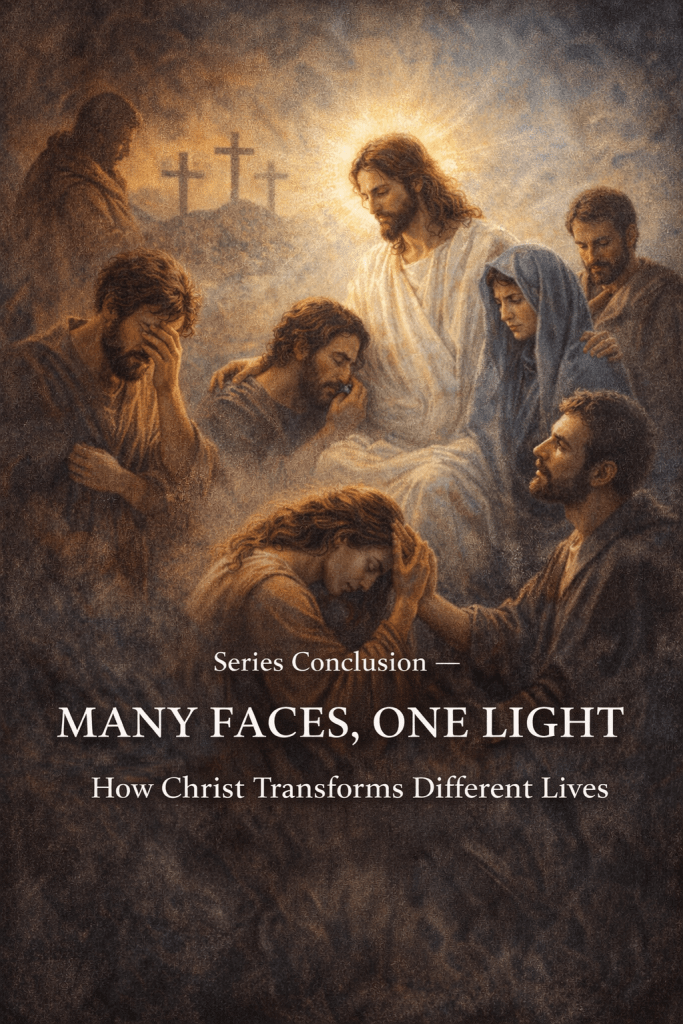
On the night of the Last Supper, they all sat at the same table.
The same bread was placed into their hands.
The same wine was lifted before them.
The same voice said, “This is my Body.”
Yet each heart carried a different interior world.
One would betray.
One would deny.
Several would flee.
One would remain close enough to hear His final breath.
A few women would stand watching when others could not.
Same Christ.
Different responses.
In the upper room (Luke 22), the apostles argued about greatness even as Christ spoke of sacrifice. In Gethsemane (Matthew 26:36–46), sleep overtook them while anguish pressed upon Him. When soldiers arrived, “they all left Him and fled” (Matthew 26:56).
Judas Iscariot walked into the night (John 13:30), carrying silver in exchange for proximity.
Saint Peter, who had sworn unwavering loyalty, trembled before a servant girl and denied Him three times (Luke 22:54–62).
John the Apostle stood at the Cross and received from Jesus the words, “Behold your mother” (John 19:27).
Mary Magdalene remained near enough to weep at the tomb and hear her name spoken by the risen Lord (John 20:16).
Thomas the Apostle doubted — and then confessed, “My Lord and my God” (John 20:28).
Fear, devotion, doubt, grief, loyalty — all were present within that small circle.
What is striking is not their inconsistency.
It is Christ’s constancy.
He knew Peter would deny Him — and still called him rock.
He knew Thomas would question — and still invited him to touch the wounds.
He knew Judas would betray — and still washed his feet.
The Light was not diminished by their weakness.
It shone through it.
The early Church understood this mystery. Writers such as Irenaeus of Lyons spoke of the fourfold Gospel — distinct voices, distinct emphases, yet one apostolic faith. Diversity of temperament did not fracture unity; it revealed the fullness of Christ refracted through different lives.
Fishermen became shepherds of souls.
A tax collector became an evangelist.
A once-possessed woman became first witness of Resurrection.
A doubter became missionary.
A denier became pastor.
The Holy Spirit did not erase personality.
He sanctified it.
And perhaps this is the deeper answer to everything this series has explored.
Discernment does not make us identical.
Cultural awareness does not make us uniform.
Integrity does not make us invulnerable.
Each of us encounters Christ through our own history, temperament, wounds, and fears. We will falter differently. We will struggle differently. We will witness differently.
Yet if surrendered, we will all be transformed by the same Light.
In these reflections we have considered:
How to see clearly in an age of confusion.
How to understand culture without being consumed by it.
How to anchor ourselves in Christ, the Lord of history.
How to guard our speech in a world quick to wound.
How to remain faithful when integrity feels lonely.
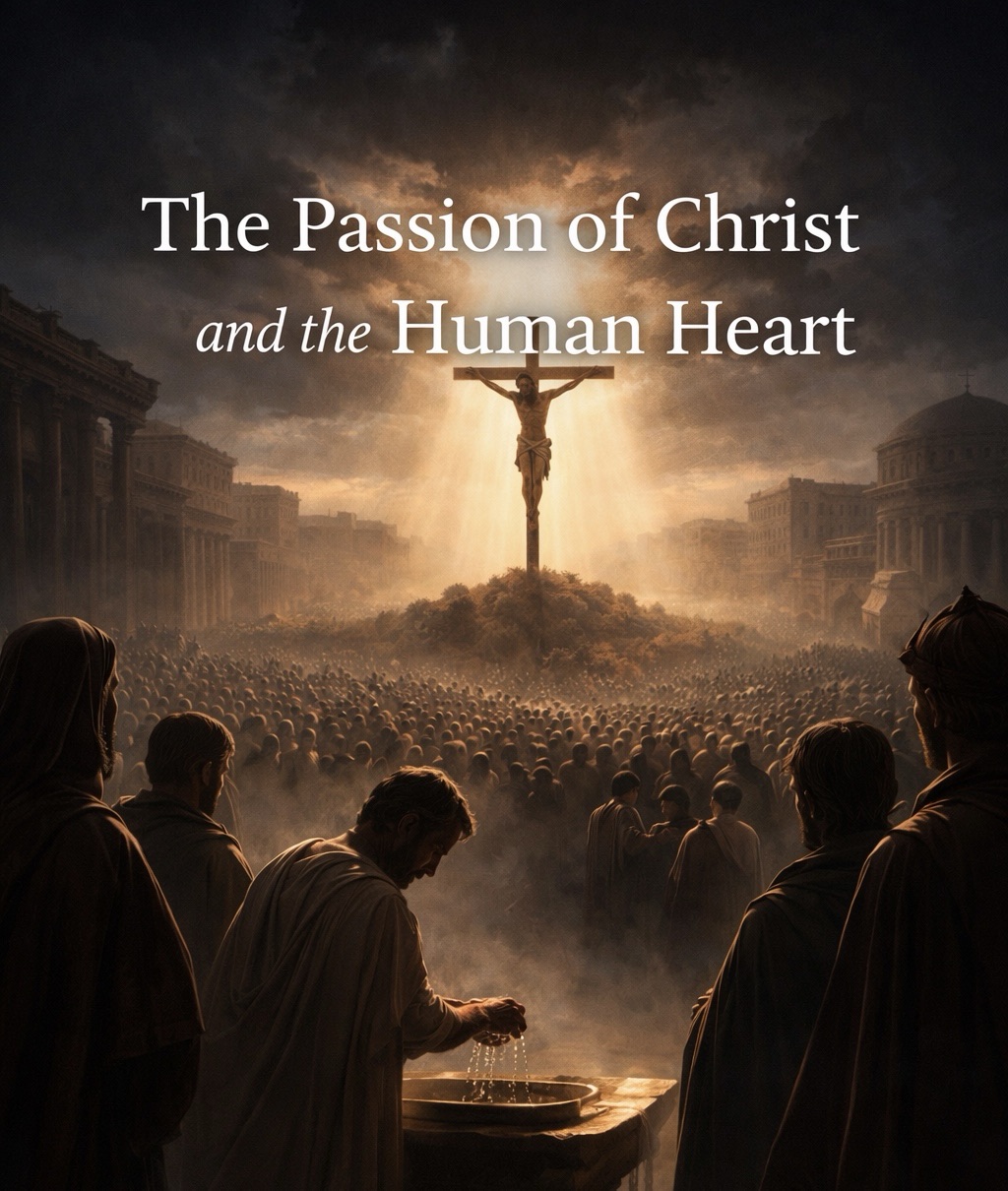
Now, as Holy Week approaches, all those themes converge.
At the Cross, discernment becomes surrender.
Cultural tension becomes crucifixion.
Speech becomes silence.
Integrity stands alone.
And yet — Resurrection waits.
History is not ultimately shaped by outrage, betrayal, denial, or fear.
It is shaped by a risen Christ who gathers fragile people and breathes upon them His Spirit (John 20:22).
Many faces.
One Light.
And that Light is not extinguished by human weakness.
It passes through it —
purifying, restoring, commissioning.
If history is in His hands, then so are we —
impulsive like Peter,
questioning like Thomas,
weeping like Mary,
anxious like Martha,
faithful like John.
Different lenses.
Same Lord.
And in His mercy,
that is enough.
Series: History in His Hands (Parts I–V + Conclusion)
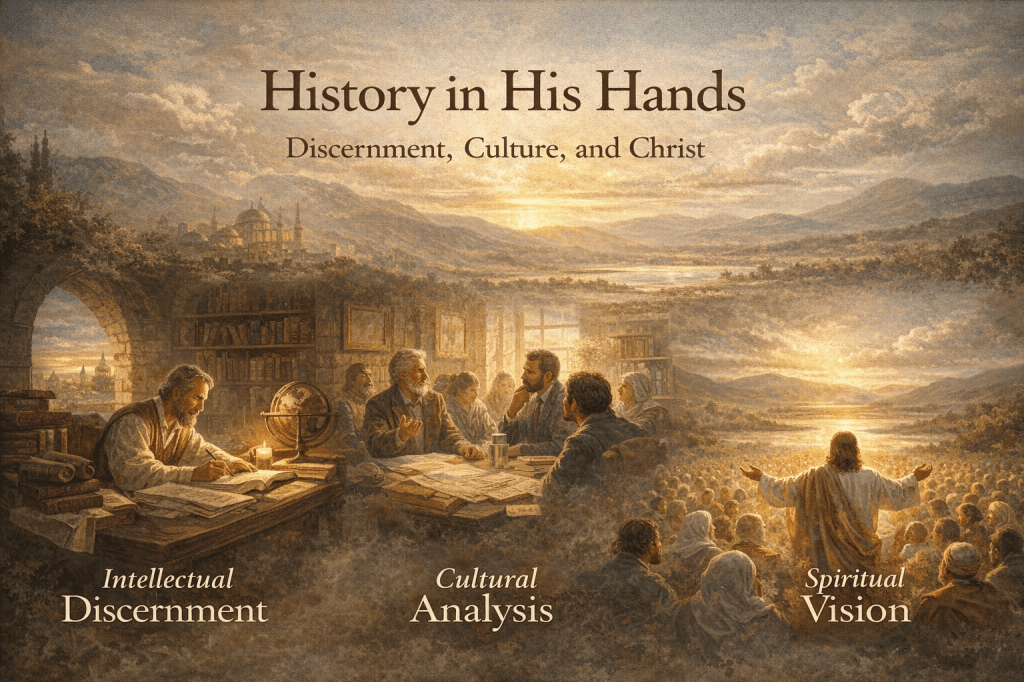
Introduction
We live in an age that seeks to decode everything — history, culture, belief, even faith itself. Predictive models promise patterns. Cultural theories offer frameworks. Intellectual paradigms attempt to organize the vast tapestry of human experience into structures that feel manageable and certain.
This three-part series emerged as a reflection on that impulse.
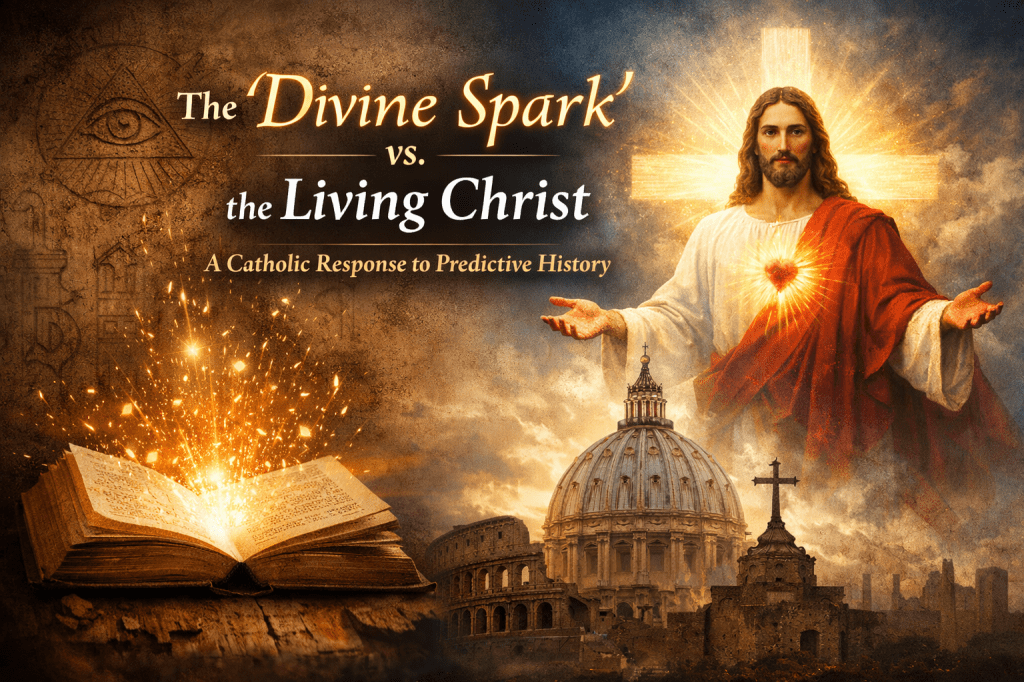
Part I — Intellectual Discernment considers the appeal and the limits of predictive approaches to history — the temptation to compress complex human realities into deterministic systems.
Part II — Cultural Analysis explores why such paradigms resonate so strongly in our time, and how contemporary thought often privileges deconstruction and reinterpretation over continuity and inheritance.
Yet reflection does not end with critique.

Part III — Spiritual Vision turns from analysis toward contemplation. Moving beyond lenses and systems, it invites the reader to consider history not merely as something constructed or decoded, but as something held — within the providence of Christ.
Together, these reflections trace a quiet movement:
from analysis to humility,
from critique to discernment,
from mastery to trust.
They are not an argument against inquiry, but an invitation to see history — and ourselves — in the light of the One who stands both within time and beyond it.
Part IV — Speech and Silence: Guarding the Tongue in an Age of Outrage
On the moral weight of language, the discipline of charity, and surrendering even our words into His hands.
Part V — The Loneliness of Integrity: Faithfulness When Others Step Back
On courage without applause, integrity without reinforcement, and entrusting reputation, relationships, and outcomes to Christ.
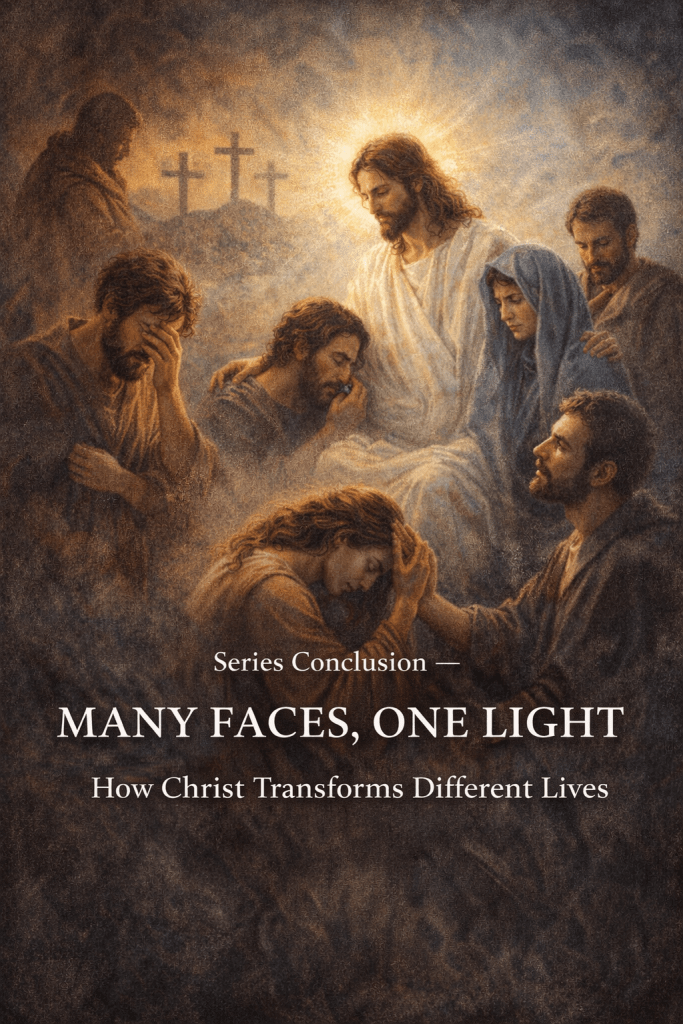
Series Conclusion — Many Faces, One Light
On the diverse witnesses who encountered Christ — Peter, Thomas, Mary Magdalene, John, and others — and how the same Light transformed fragile people into bearers of the Gospel.


 Be Inspired!
Leave a comment