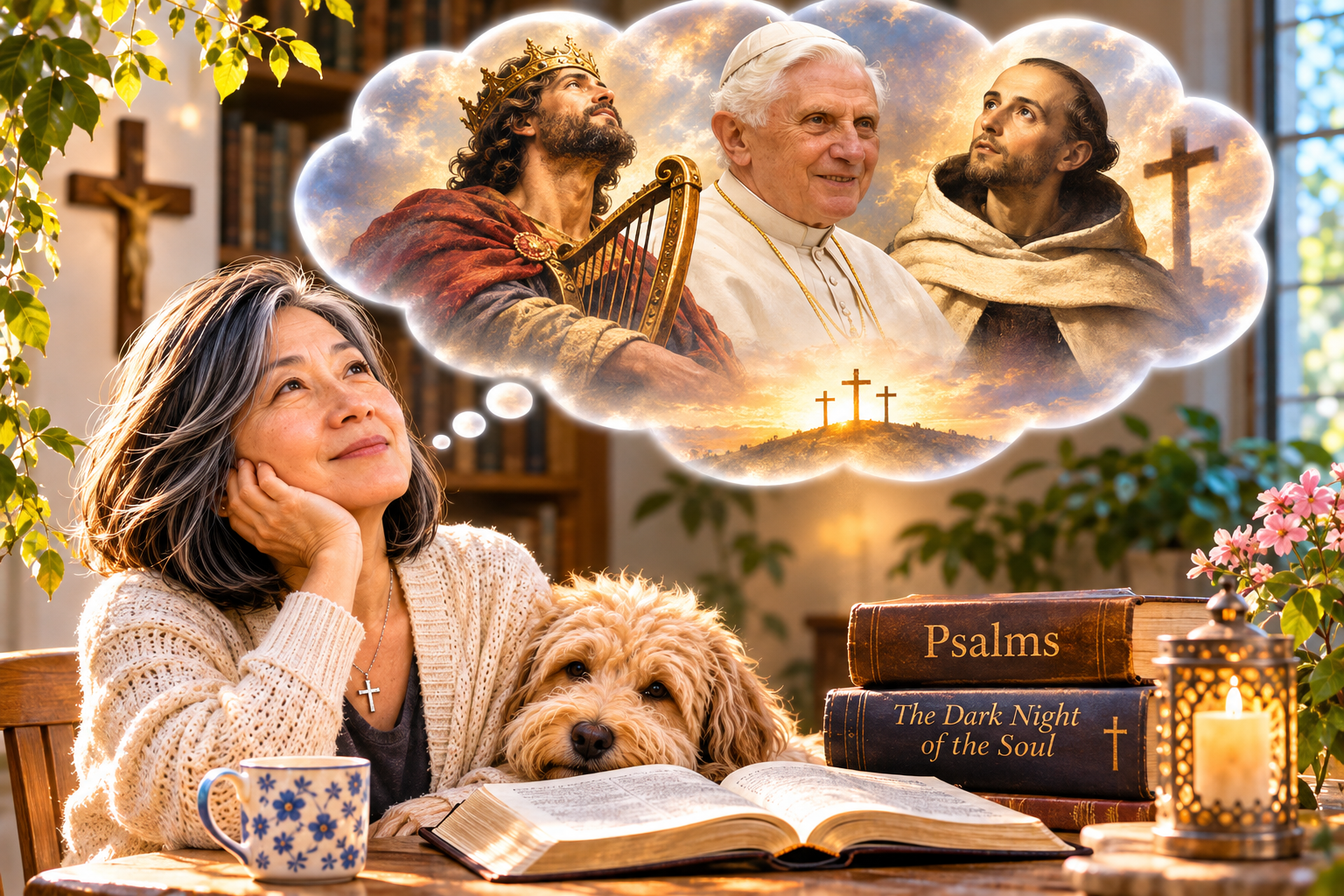
Reflections on David, Christ, Pope Benedict XVI, and St. John of the Cross
A Question That Led Me Deeper
Sometimes a single word in Scripture can lead us into a much larger reflection.
Recently, I was listening to a Christian teacher discussing Psalm 22, particularly the verse in which the psalmist says, “I am a worm, not a man” (Psalm 22:7).
The teacher explored the symbolism of the worm in relation to Christ’s humiliation and suffering. It was an interesting interpretation, but I found myself wanting to understand more.
Who originally wrote this psalm? What was happening in the life of the person who prayed it? And why does a prayer that begins with such anguish end with praise?
As I explored these questions, I found myself returning to Pope Benedict XVI’s reflections on Psalm 22 and, eventually, to St. John of the Cross.
What began as a question about one word became a reflection on suffering, faith, and the presence of God when He seems most distant.
The Original Prayer: A Cry from the Darkness
Psalm 22 is traditionally attributed to King David. Its ancient heading includes the words The Doe of the Dawn, generally understood as a musical direction. We cannot say with certainty when the psalm was composed or what particular event inspired it.
What we do know is that it gives voice to someone experiencing terrible suffering.
The psalmist feels abandoned, humiliated, and surrounded by enemies. His physical suffering is described in vivid language. He feels powerless, almost stripped of his humanity.
Yet something remarkable happens.
Even while crying out in anguish, he continues to address God as my God.
He remembers how God delivered his ancestors. He remembers God’s care from the beginning of his own life. Although he cannot understand the silence he is experiencing, he continues praying.
And then the psalm changes.
The lament becomes thanksgiving. The suffering person begins to proclaim God’s faithfulness before the community. The praise expands beyond one individual, beyond Israel, and eventually toward all the nations and generations yet to come.
The psalm does not explain why the suffering happened. Nor does it pretend that the anguish was insignificant.
Instead, it holds suffering and faith together.
That is what first caught my attention.
David: Our Humanity Reflected
Although we cannot establish the precise circumstances behind Psalm 22, its traditional association with David invites us to consider his life.
David was a man of extraordinary faith, but he was not without serious moral failures.
He experienced fear, persecution, betrayal, and grief. He also sinned, recognized his wrongdoing, and cried out for God’s mercy.
In Psalm 51, we encounter David’s repentance. In 2 Samuel 6, we encounter another side of him: David dancing before the Lord with all his might.
I find that image especially beautiful.
David’s relationship with God was not confined to sorrow or repentance. It also overflowed with joy.
His life reminds me that our spiritual journeys are rarely simple. We can love God deeply and still struggle. We can fail, repent, begin again, and discover joy.
But we must also be careful not to confuse every kind of darkness.
The darkness caused by sin is not the same as the darkness of suffering. Neither is necessarily the same as the spiritual purification described by the mystics.
And we cannot judge the condition of someone’s soul simply by the darkness they are experiencing.
That is an important lesson in compassion.
Christ: The Cry from the Cross
The opening words of Psalm 22 take on extraordinary significance in the Gospels.
As Jesus hangs upon the Cross, He cries:
“My God, my God, why have you forsaken me?” (Matthew 27:46; Mark 15:34).
For Christians, these words connect the ancient prayer of the suffering righteous person with the Passion of Christ.
The Gospel accounts also echo other parts of Psalm 22: the mockery, the humiliation, and the dividing of garments.
But Christ is not simply another suffering person.
He is the eternal Son of God, fully divine and fully human, without sin. His suffering is real, and His freely offered sacrifice is uniquely redemptive.
This is why I believe we must be careful not to reduce Psalm 22, or Christ’s Passion, to humiliation alone.
The humiliation matters. The suffering matters. The death matters.
But the Resurrection matters too.
They belong together within the Paschal Mystery.
Pope Benedict XVI: When God Seems Silent
On September 14, 2011, Pope Benedict XVI gave a catechesis on Psalm 22 that expresses something I have come to recognize in my own spiritual reflections.
He did not minimize Christ’s suffering.
Jesus experienced genuine human anguish. He was betrayed, denied, mocked, and abandoned by almost all His followers. His cry from the Cross was not a performance or merely a quotation chosen for its symbolism.
It expressed the terrible reality of His Passion.
Yet Benedict also explained that this cry was not a surrender of faith.
Jesus’ words evoke Psalm 22, a prayer that moves from suffering toward praise. Benedict noted the Jewish custom of citing the opening of a psalm to refer to the larger prayer.
Most importantly, Jesus continues addressing the Father.
The Son’s divine communion with the Father is not broken, even as He experiences the depths of human suffering.
Benedict’s reflection helped me recognize something essential.
The experience of God’s silence is not necessarily evidence of God’s absence.
This does not mean that suffering is imaginary or that faith immediately removes our pain.
It means that the story of salvation does not end at the Cross.
On the road to Emmaus, the Risen Christ helps His disciples understand the relationship between His suffering and His glory (Luke 24:26).
The Passion and Resurrection are not competing realities. They belong to the same mystery of redemption.
I agree deeply with Benedict’s insistence that we must hold both together.
We cannot rush past Good Friday to reach Easter Sunday.
But neither should we forget Easter Sunday when standing at the foot of the Cross.
St. John of the Cross: The Darkness of the Soul
As I reflected on Benedict’s teaching, my thoughts turned naturally to St. John of the Cross.
In his writings on the Dark Night, John describes the spiritual purification through which a soul may experience the loss of familiar consolations.
Prayer may no longer bring the same comfort. God’s presence may no longer be felt in the way it once was.
Yet, in the spiritual night John describes, God has not necessarily withdrawn His love.
The soul is learning to love beyond the feelings and consolations upon which it once depended.
This is not the same as Christ’s suffering on the Cross. Nor should we assume that every painful experience is a Dark Night of spiritual purification.
Grief, illness, emotional distress, the consequences of sin, and spiritual purification are different realities, even when they sometimes overlap in our experience.
Nevertheless, John’s teaching offers an important insight.
Faith cannot always be measured by what we feel.
There are moments when we continue praying without consolation, when we seek God without experiencing His nearness, and when we must learn to trust without understanding.
I recognize something of this in my own journey.
There have been seasons when I searched, questioned, struggled, and could not see clearly where God was leading me.
Looking back, I have come to understand those experiences differently.
Not every darkness was the same. Not every difficulty had a spiritual explanation.
But through the years, I have increasingly recognized something that has become central to my faith:
Grace was always there, even when I could not see it.
What Psalm 22 Means for Us Today
Perhaps this is why Psalm 22 continues to speak so powerfully across the centuries.
We live in a world where suffering is often something we want to explain, solve, or escape as quickly as possible.
Sometimes we are uncomfortable with another person’s anguish. We want to offer reassurance before we have fully listened.
But Psalm 22 begins by allowing suffering to speak.
The psalmist asks why.
He remembers.
He pleads.
He continues calling upon God.
And I find something deeply human in that.
We do not always understand what is happening in our lives. We may experience losses that cannot be repaired, prayers that seem unanswered, or seasons when hope is difficult to recognize.
Faith does not require us to pretend otherwise.
Nor should we assume that everyone who suffers will experience a clear resolution in this life.
Christian hope rests not upon the promise of an easy journey, but upon Christ, who entered human suffering and conquered death.
When I think of David, I remember not only his sorrow and repentance, but also his exuberant joy before the Lord.
When I think of St. John of the Cross, I remember that love can continue its work beyond what our senses can recognize.
And when I return to Pope Benedict XVI, I am reminded that Christ’s cry from the Cross must be heard within the fullness of His Passion and Resurrection.
The darkness is real.
The suffering is real.
But darkness is not the whole story.
From Darkness to Light
What began for me as a question about the word worm in Psalm 22 became something much larger.
I began by wanting to understand a biblical image. I found myself contemplating the ancient psalmist, David’s humanity, Christ’s redemptive suffering, Benedict’s theology, and John’s understanding of spiritual darkness.
And through it all, one thought remained.
The person who cries out to God in suffering has not necessarily stopped believing.
Sometimes that cry is itself an expression of faith.
We may not always feel God’s presence. We may not understand His silence. And we may not see the light while we are still walking through the darkness.
Yet the Christian story invites us to look beyond what we can presently see.
Psalm 22 begins with a question of abandonment and ends with a proclamation of God’s faithfulness to generations yet unborn.
In Christ, we encounter the fullness of that hope.
And perhaps, as we continue our own journeys, we may discover that grace has been accompanying us in ways we could not recognize at the time.
Not because the darkness was never real.
But because God’s love was never limited to what we could see.
Grace was always there.
Scripture and References
Sacred Scripture — New American Bible, Revised Edition (NABRE)
Psalm 22 — https://www.usccb.org/bible/psalms/22
Psalm 51 — https://www.usccb.org/bible/psalms/51
2 Samuel 6:14–16 — https://www.usccb.org/bible/2samuel/6
Matthew 27:46 — https://www.usccb.org/bible/matthew/27
Mark 15:34 — https://www.usccb.org/bible/mark/15
John 19:23–24 — https://www.usccb.org/bible/john/19
Hebrews 2:12 — https://www.usccb.org/bible/hebrews/2
Luke 24:26 — https://www.usccb.org/bible/luke/24
Pope Benedict XVI, General Audience, September 14, 2011 — https://www.vatican.va/content/benedict-xvi/en/audiences/2011/documents/hf_ben-xvi_aud_20110914.html
St. John of the Cross, The Dark Night, Books I and II.
Catechism of the Catholic Church, 601–618 — https://www.usccb.org/beliefs-and-teachings/what-we-believe/catechism/catechism-of-the-catholic-church/epub/index.cfm?p=24-chapter3.xhtml
Second Vatican Council, Dei Verbum, 12 — https://www.vatican.va/archive/hist_councils/ii_vatican_council/documents/vat-ii_const_19651118_dei-verbum_en.html


Leave a Reply