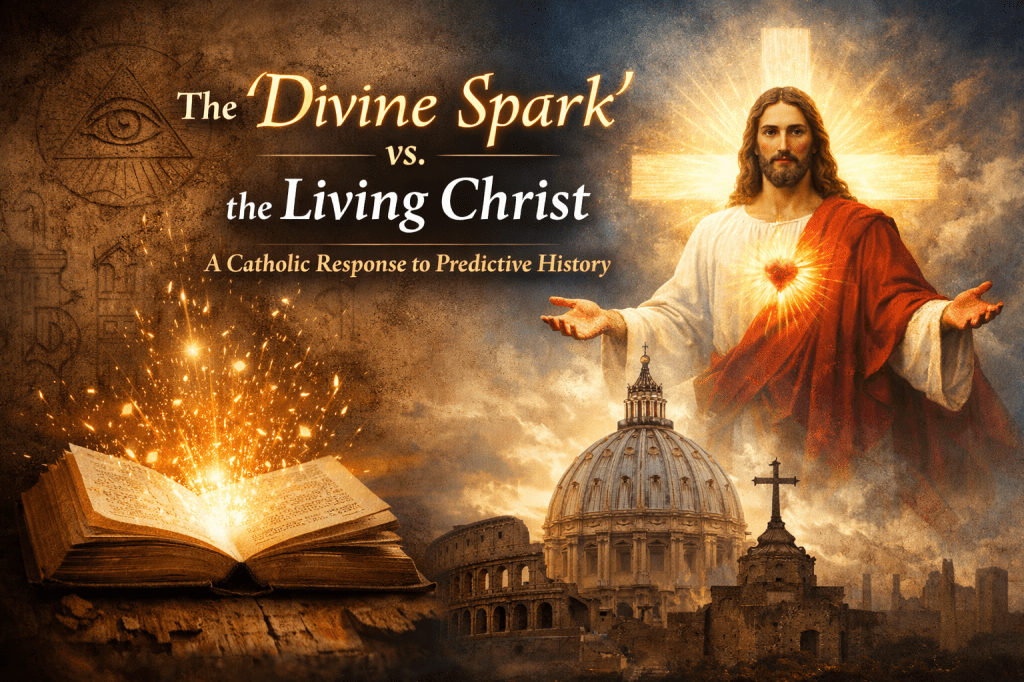
When History Becomes a Single Story
Recently, I encountered the work of Professor Jiang and his YouTube lectures on what he calls “predictive history.” His presentations are intellectually stimulating and, at times, thought-provoking. Yet beneath the surface lies a concerning paradigm.
His method compresses sweeping historical events into a single anthropological and literary framework. Complex civilizations — layered with cultural, political, theological, and social nuance — are reduced to one overarching explanatory structure.
But history is not a straight line.
It is more like a tapestry. Threads overlap, clash, fray, and are rewoven. To force all of history into a tidy system risks distorting the very truth it claims to uncover.
The Claim: Christianity as Imperial Invention
A recurring theme in his lectures is open disdain for Christianity — particularly the Catholic Church. He proposes that the Church was engineered by the Roman Empire, that St. Paul was essentially a foreign agent consolidating imperial power, and that Catholicism itself is demonic in origin.
These claims directly contradict both Scripture and historical evidence.
St. Paul writes:
“Paul, an apostle — not from men nor through man, but through Jesus Christ and God the Father who raised him from the dead.” (Galatians 1:1)
His conversion (Acts 9:1–19) and his sufferings — imprisonments, beatings, persecution (2 Corinthians 11:23–27) — hardly reflect the life of an imperial operative. He was eventually martyred in Rome.
Moreover, the Church predates Constantine by nearly three centuries. Jesus Himself declared:
“You are Peter, and on this rock I will build my Church, and the gates of Hades shall not prevail against it.” (Matthew 16:18)
And St. Paul affirms:
“For no other foundation can any one lay than that which is laid, which is Jesus Christ.” (1 Corinthians 3:11)
The Church’s foundation is not imperial policy — it is Christ.
The “Divine Spark” and the Echo of Gnosticism
Professor Jiang centers his thesis on what he calls the “divine spark” — an inner light from the Creator buried beneath materialism and the corruption of a world he describes as fundamentally evil and under Satanic dominion.
There is a partial truth here.
Scripture teaches that humanity is created in the image and likeness of God (Genesis 1:27). The Gospel of John proclaims Christ as:
“The true light that enlightens every man.” (John 1:9)
The Catechism of the Catholic Church (CCC 27) teaches that the human person has an innate desire for God because we are created by Him and for Him.
But Christianity does not teach that salvation comes from uncovering hidden knowledge within ourselves. That idea resembles ancient Gnosticism — a worldview the early Church firmly rejected.
Instead, Scripture teaches:
“For all have sinned and fall short of the glory of God.” (Romans 3:23)
And:
“For by grace you have been saved through faith; and this is not your own doing, it is the gift of God.” (Ephesians 2:8)
The light within us is not self-generated. It is grace.
Is the World Evil?
It is true that Scripture acknowledges spiritual warfare:
“The whole world is in the power of the evil one.” (1 John 5:19)
Yet Christianity never teaches that creation itself is evil. In Genesis we read:
“God saw everything that he had made, and behold, it was very good.” (Genesis 1:31)
The solution is not escape from matter — but redemption of it.
“And the Word became flesh and dwelt among us.” (John 1:14)
The Incarnation destroys the idea that material reality is inherently corrupt. God enters it. Sanctifies it. Redeems it.
Apocryphal Texts and the Canon
Some modern narratives elevate texts like the Gospel of Thomas or the Book of Enoch as hidden keys to truth. While these writings provide historical insight into early Jewish and Christian thought, they are not part of the canonical Scriptures discerned by the Church under the guidance of the Holy Spirit (John 16:13).
The Church did not suppress truth — she safeguarded apostolic teaching.
As St. Paul instructs:
“Test everything; hold fast what is good.” (1 Thessalonians 5:21)
The Real Danger: Uncritical Acceptance
The deeper danger is not that such ideas exist — intellectual exploration is healthy.
The danger lies in accepting sweeping conclusions without disciplined research, especially among young minds seeking meaning in a fragmented age.
The Catholic Church openly acknowledges her human failures. Wheat and weeds grow together (Matthew 13:24–30). There have been scandals, corruption, and grave sin.
But corruption within members does not negate Christ’s promise.
“The light shines in the darkness, and the darkness has not overcome it.” (John 1:5)
Conclusion: The Light Is a Person
There is indeed a light within humanity.
But it is not a hidden spark unlocked by secret knowledge.
It is participation in divine life poured into our hearts through the Holy Spirit (Romans 5:5). It is grace. It is sacramental. It is relational.
Christ did not give us a code to decipher.
He gave us Himself.
“I am the way, and the truth, and the life.” (John 14:6)
History cannot be reduced to a predictive formula. Nor can the Church be dismissed as an imperial fabrication. For two millennia she has endured empires, ideologies, persecutions, and internal crisis.
That endurance alone demands serious study — not casual dismissal.
The Light is not an abstract spark.
It is a Person.
And His name is Jesus Christ.
A Personal Note
I rarely review or critique the work of others publicly. That has never been my focus.
However, when I encountered Professor Jiang’s lectures, I felt compelled to lend a Catholic voice to the conversation. Not out of hostility, but out of concern. I saw what I believe to be a genuine spiritual and intellectual danger — particularly for young minds searching for meaning, and for those who may accept compelling narratives without doing the deeper work of research and critical thought.
We live in an age shaped by social media and YouTube — platforms where ideas travel faster than discernment.
And discernment is no longer optional.
Sacred Scripture reminds us:
“Beloved, do not believe every spirit, but test the spirits to see whether they are from God.” (1 John 4:1)
In every generation, Catholics are called not merely to consume ideas, but to examine them in the light of Christ.
May we always seek truth — not the most persuasive voice, but the enduring one.
God Bless 🙏❤️
Predictive History and the Hunger for Control: Why These Narratives Are So Popular (Part II)
https://rejoiceandpraise.ca/2026/03/03/part-iii-when-history-is-held-in-his-hands/
Part IV — History in His Hands: Speech, Silence, and the Discipline of the Tongue


 Be Inspired!
Leave a comment