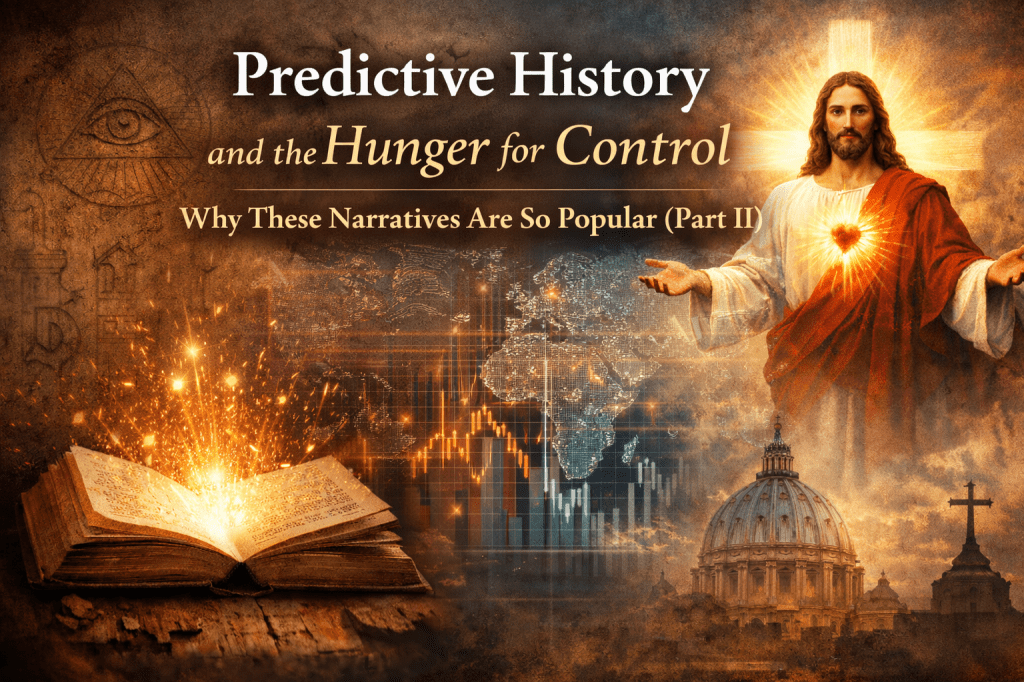
my previous post, I examined the theological concerns surrounding modern “predictive history” narratives and their dismissal of Christianity. I would like now to step back from any one personality and explore something deeper:
Why is this kind of methodology so compelling in our time?
Why do these sweeping historical frameworks resonate so strongly, particularly with younger audiences?
The answer tells us something important about our cultural moment.
A World That Feels Out of Control
We are living in an age of rapid change. Social media delivers global crises in real time. Political polarization intensifies. Institutions once trusted now feel unstable.
In such a climate, a system that claims to decode history is deeply comforting.
Predictive models offer clarity:
Civilizations rise and fall in patterns. Institutions corrupt in predictable cycles. Religious movements can be explained structurally.
In other words: nothing is random.
This satisfies something profound in the human heart. As Ecclesiastes reminds us:
“He has put eternity into man’s mind.” (Ecclesiastes 3:11)
We long for coherence. We want history to make sense.
The Appeal of “Hidden Knowledge”
There is also a psychological dimension.
Predictive frameworks often carry the subtle promise that the viewer is gaining insight unavailable to the masses. You are not merely consuming information; you are awakening to the underlying code of civilization.
This is not new.
Ancient Gnosticism operated on a similar premise — salvation through special knowledge accessible to the initiated. The early Church rejected this precisely because Christianity is not built on secret insight but public revelation.
Jesus tells His disciples:
“What I tell you in the dark, utter in the light.” (Matthew 10:27)
Truth in Christianity is not hidden behind esoteric interpretation. It is proclaimed openly.
Distrust of Institutions
Another reason for the popularity of predictive paradigms is widespread institutional distrust.
Political scandals. Media bias. Academic ideology. Even failures within the Church herself.
It is understandable that many, especially university students, feel disillusioned.
When an influencer presents a grand theory explaining how institutions manipulate power structures — including religion — it resonates.
Yet there is a danger here.
Skepticism can become cynicism. And cynicism often flattens nuance.
The Catholic Church openly acknowledges the sinfulness of her members. Scripture itself tells us that wheat and weeds grow together until the harvest (Matthew 13:24–30). But corruption within individuals does not automatically invalidate divine origin.
The Problem with Reductionism
The greatest weakness of predictive historical models is reductionism.
They reduce:
Faith to power strategy. Conversion to social engineering. Revelation to literary construction.
But Christianity insists that history is not merely structural — it is personal.
“And the Word became flesh and dwelt among us.” (John 1:14)
The Incarnation disrupts every deterministic model. God enters history not as a pattern but as a Person.
St. Paul’s conversion alone defies structural inevitability. A persecutor becomes an apostle. An enemy becomes a martyr. History turns not because of predictable cycles, but because of grace.
Free Will and Providence
Predictive history often carries an undercurrent of inevitability — as if civilizations must collapse according to historical law.
But Christianity affirms human freedom:
“Choose this day whom you will serve.” (Joshua 24:15)
History is shaped by decisions — moral, spiritual, personal.
Above all, it unfolds under Divine Providence, not human forecasting.
“For my thoughts are not your thoughts, neither are your ways my ways, says the Lord.” (Isaiah 55:8)
The Christian view of history is neither purely cyclical nor mechanistic. It is salvific.
Creation. Fall. Redemption. Consummation.
The climax is not institutional power, but the Cross.
Why It Speaks to Young Minds
For many young people today:
Religion feels inherited rather than examined. Institutions feel compromised. The future feels uncertain.
A predictive paradigm feels empowering. Analytical. Independent.
It gives the sense of stepping outside the system and seeing the machinery beneath it.
Yet it often replaces one grand narrative with another — equally rigid, equally dogmatic.
Discernment is crucial.
“Test everything; hold fast what is good.” (1 Thessalonians 5:21)
A Catholic Philosophy of History
Christianity does not deny patterns in history. Nor does it deny corruption or abuse of power.
But it refuses to reduce everything to those patterns.
It proclaims instead that history has meaning because it has a Lord.
“Jesus Christ is the same yesterday and today and for ever.” (Hebrews 13:8)
The ultimate key to history is not prediction — it is Revelation.
Not a hidden spark unlocked by elite interpretation.
But a Light that entered the world.
And that Light cannot be engineered, constructed, or dismantled by empire.
An Aside from My Own Academic Journey
Perhaps part of why I recognize the danger in sweeping paradigms is personal.
When I was a graduate student, I remember enthusiastically reducing nearly everything through the structuralist lens of Claude Lévi-Strauss. Culture, myth, religion, narrative — all of it could be mapped into underlying binary systems. It was elegant. Clean. Intellectually satisfying.
Later, post-structuralism entered my framework. Then deconstruction. Entire civilizations could be dismantled conceptually — texts taken apart, meanings destabilized, traditions reframed as power constructions.
These methodologies were enormously popular in the 1980s and 1990s. To question them was almost to betray intellectual seriousness.
And yet, over time, I began to see something unsettling.
The model always won.
No matter the evidence, the paradigm shaped the outcome. Reality was pressed into the framework rather than the framework tested against reality.
Today, the academic climate often feels even more fluid. “Anything goes” so long as it challenges traditional methodology or empirical grounding. To defy inherited structures is frequently valued more than to understand them.
Having lived through those intellectual movements, I recognize the pattern when I see it again — even when it appears under a different name.
Paradigms are powerful tools.
But they become dangerous when they stop being tools and start becoming total explanations.
God Bless 🙏💕



 Be Inspired!
Leave a comment