
Aside: Hard hitting truths. Something for those of us in the faith to think about.
https://www.lifesitenews.com/news/bishop-strickland-all-saved-conversion/
From LifeSite News:
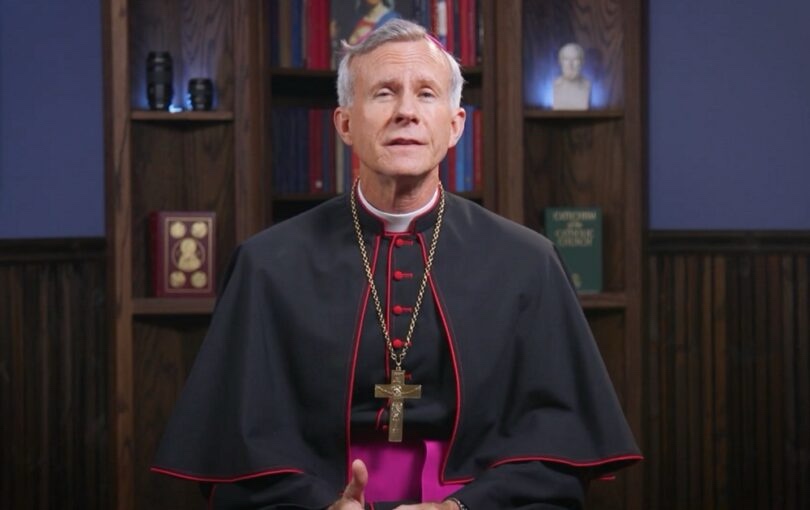
Bishop Strickland warned against trying ‘to offer a way of salvation other than through Jesus Christ and His Church’ and urged Catholics ‘to embrace the wondrous metanoia God offers us only through His Son’ in his latest pastoral message.
Bishop Joseph Strickland of Tyler, Texas, issued a new pastoral letter today, October 10, 2023. Below is the full text.
My Dear Sons and Daughters in Christ,
It is an honor and a joy to continue to share the basic truths of our Catholic faith with you, as we now delve more deeply into the sixth truth I outlined in my Pastoral Letter of August 22, 2023: “The belief that all men and women will be saved regardless of how they live their lives (a concept commonly referred to as universalism) is false and is dangerous, as it contradicts what Jesus tells us repeatedly in the Gospel. Jesus says we must ‘deny ourselves, take up our cross and follow Him.’ (Matt 16:24). He has given us the way, through His grace, to victory over sin and death through repentance and sacramental confession. It is essential that we embrace the joy and hope, as well as the freedom, that come from repentance and humbly confessing our sins. Through repentance and sacramental confession, every battle with temptation and sin can be a small victory that leads us to embrace the great victory that Christ has won for us.”
We are all sinners, and we are all in need of a Savior because we are all born into original sin and, therefore, subject to its consequences. (cf. Rom 5:12-21). Original sin was the first sin that was committed by our first parents, Adam and Eve, in disobedience of God. That original sin is now a hereditary stain with which we are all born on account of our descent from Adam and Eve. Thus, original sin is an ongoing privation of God’s grace, and because of its effect in our lives, we as humans are born in a state of separation from God. If we were left in this state of original sin, we would be eternally separated from God because nothing unclean will be allowed to enter into Heaven. (cf. Rev 21:27). However, through Baptism, God has made a way for us to be justified in Him – through Jesus Christ alone – and to remove not only the stain of the original sin of our first parents which we carry, but also the stain of all actual sins we ourselves commit. And for our sins after we have been baptized, God has given us the Sacrament of Reconciliation (also called Confession or Penance) in order to allow us to repent and be cleansed of the stain of our sins.
From the Catechism of the Catholic Church, we read that “Sin is an offense against God: ‘Against you, you alone, have I sinned, and done that which is evil in your sight.’ Sin sets itself against God’s love for us and turns our hearts away from it. Like the first sin, it is disobedience, a revolt against God through the will to become ‘like gods,’ knowing and determining good and evil. Sin is thus ‘love of oneself even to contempt of God.’ In this proud self-exaltation, sin is diametrically opposed to the obedience of Jesus, which achieves our salvation.” (CCC 1850).
That first sentence is packed with deep theological insight – “Sin is an offense against God.” Consider that God is infinitely good and holy, and He is infinite love. Thus, according to St. Thomas Aquinas in his Summa Theologica, when we sin, we sin against the infinite, and thus our sins are infinitely offensive to Him. “Now a sin which is committed against God is infinite: because the gravity of a sin increases according to the greatness of the person sinned against (thus it is a more grievous sin to strike the sovereign than a private individual) and God’s greatness is infinite. Therefore, an infinite punishment is due for a sin committed against God.” (Summa Theologica; I-II, q.87, a. 4, obj. 2).
In our current society, which is so afflicted with the errors of moral relativism, the temptation is all too strong to look at the weight of sin from a human perspective rather than from the divine perspective. We make excuses for our sins, explaining that the things we do are “not all that bad.” Further, the temptation exists to presume upon the mercy of God, assuming that surely a loving and merciful God will overlook our disobedience and failures even if we do not seek forgiveness because He is infinitely merciful. This line of thinking sometimes progresses to our assuming that salvation will ultimately be offered to all people simply because God is infinitely merciful, and therefore all men will be saved. This is the error of universalism. This error could lead one to ask, “What then is the point of conversion of heart to Jesus Christ? Why bother following Christ at all?” This is extremely dangerous, as it prevents us from seeing the need for true and authentic repentance. It is a deadly indifference that imperils our immortal souls and puts us at eternal risk of separation from God. “For the wages of sin is death, but the gift of God is eternal life in Christ Jesus our Lord.” (Rom 6:23). Although God does make an accommodation for our weak and fallen human nature, that accommodation is through the sacraments of Baptism and Reconciliation (sacramental confession) which move us into a right relationship with Our Savior Jesus Christ, through whom alone our salvation comes.
Sin damages our relationship with God and cuts us off from sharing in His life of grace, and we cannot restore this life of grace ourselves, as we are finite beings with only finite capabilities, and the One whom we have offended through sin is infinite. We are not capable of making infinite reparations. Thus, we can only reestablish a life of grace through the One who is infinite. He alone is capable of restoring life. “When the disciples heard this, they were greatly astonished and said, Who then can be saved?’ Jesus looked at them and said, ‘For human beings this is impossible, but for God all things are possible.’” (Matt 19:25-26). Salvation comes by Jesus alone (c.f. Acts 4:12). The saving grace that Jesus Christ won for us on the cross is a free gift from God that man receives through repentance, faith, and baptism. Once we are baptized into Christ, it is through repentance and sacramental confession that every battle with temptation and sin can be a small victory that leads us to embrace the great victory that Christ has won for us.

 Be Inspired!
Leave a comment