Part 1:
The Courage and Hope of Daniel
In the quiet rhythm of our daily lives—amid family joys and struggles, creative callings, and the ordinary faithfulness of work and prayer—we often sense we are living as exiles in a world that feels increasingly like Babylon. The Book of Daniel, with its stories of courage and its soaring visions, meets us right there. It does not thunder condemnation, but rather draws us into lived experience: the experience of young people uprooted, pressured to conform, yet choosing fidelity to the living God. Through their story, the Holy Spirit invites us today, as Catholics and followers of Christ Jesus, to reflect deeply on what it means to walk faithfully in our own moment in history.
God’s Gentle Sovereignty Over Every Chapter of Our Lives
Daniel and his companions found themselves far from home, surrounded by a powerful empire. Yet again and again, the book reveals a tender yet unshakable truth: God holds the times and seasons in His hands. He raises up and brings low kings and kingdoms, not out of harshness, but so that His eternal kingdom—the one “not made by human hands”—may shine through.
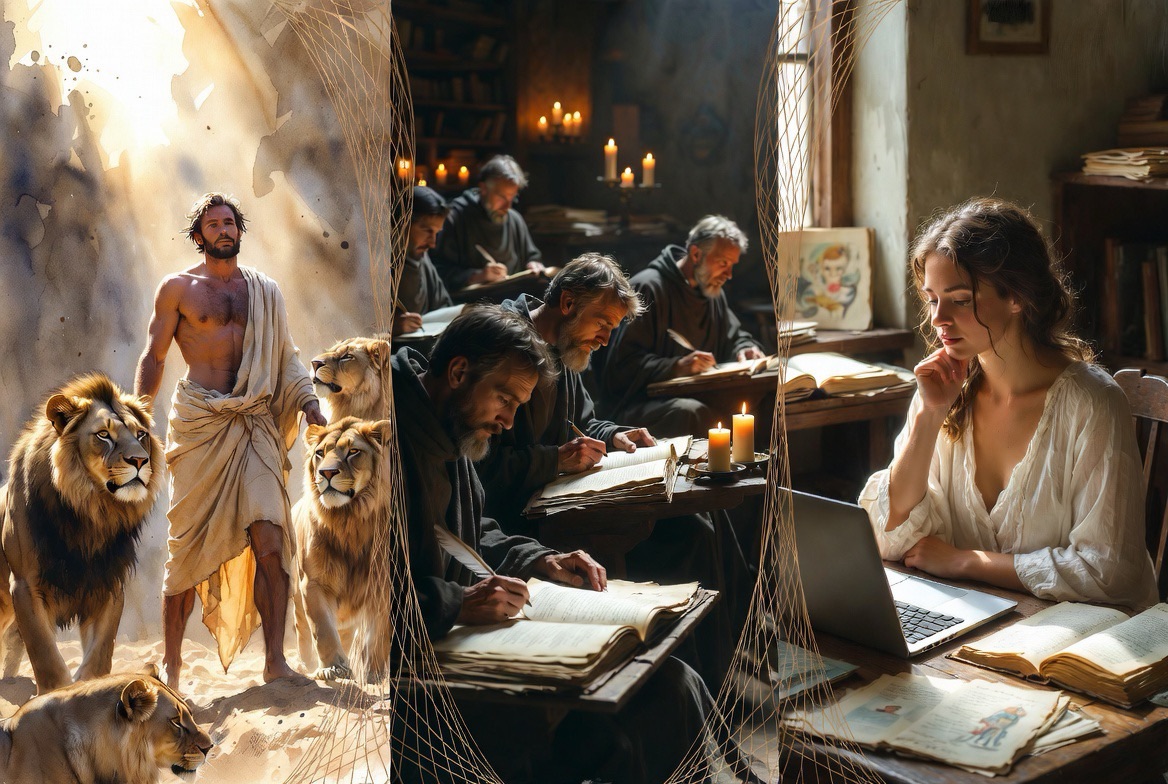
In our world today, with its shifting powers, cultural pressures, and rapid changes, this brings such comfort. Whether we face personal trials, family crossroads, or the broader currents of society, we are invited to pause and remember: history is not spinning out of control. The same God who protected Daniel in the lions’ den and revealed mysteries to him in the night watches over us.
Faithfulness Born of Small, Daily Choices
What touches the heart most are the quiet resolutions: Daniel “purposed in his heart” not to defile himself. His friends stood firm before the fiery furnace. These were daily choices rooted in love for God.
We recognize this in our own lived experience—the small moments when culture whispers for us to compromise. Daniel’s story gently asks us: What might it look like today to purpose in our hearts to remain faithful? Not with rigidity, but with the quiet strength that comes from relationship with the Lord. In the furnace of daily life, an unseen Presence walks with us.
Wisdom, Prayer, and the Hope of Resurrection
Daniel’s gift was wisdom given by God. In our age of endless information, we too are invited to seek this discerning heart through Scripture, prayer, and the guidance of the Church. His prayer in chapter 9, full of honest confession and intercession, mirrors our own longings—for our families, our Church, and our broken world.
And then there is the radiant hope: the promise of resurrection and the Son of Man receiving everlasting dominion. This lifts our eyes beyond present struggles. It reminds us that no suffering is wasted and that the kingdom of God is already breaking in through acts of love and courageous witness.
The Book of Daniel is not primarily about decoding the future. It is a mirror and a companion for our pilgrimage. It shows us that ordinary believers can live with integrity, pray with persistence, and shine with hope even in difficult seasons.
I invite you to open its pages slowly. Bring your questions, your joys, and your dryness into prayer. Let the Holy Spirit speak personally to you. May these reflections stir in you a deeper hunger to know the Lord more intimately. In Him, we find not only courage for today but the promise of life everlasting.
Part 2:
Discernment Across the Ages
There is a beautiful thread that runs through the long story of how God’s people have preserved, shared, and reflected His truth. From the patient, prayerful hands of monks illuminating manuscripts by candlelight, to the printing press that made Scripture and the writings of the saints accessible to everyday believers, to computers, the internet, and now AI—each advance has been like a new loom for weaving the same eternal story.
What remains constant is discernment: that gentle, ongoing listening to the Holy Spirit while testing everything against the living Word of God. This is a deeply biblical and Catholic practice, one that keeps our hearts anchored in Christ no matter what tools are placed in our hands.
One of the clearest invitations to this kind of testing comes from 1 John 4:1:
“Beloved, do not believe every spirit, but test the spirits to see whether they are from God, because many false prophets have gone out into the world.”
John wrote these words in a time of confusion and competing voices. He urged believers to examine teachings, inspirations, and influences—not out of fear, but out of love for the truth. We test by asking: Does this align with the Gospel of Jesus Christ? Does it bear the fruit of the Spirit—love, joy, peace, patience, and the rest (Galatians 5:22-23)? Does it draw us closer to God and neighbor?
We hear similar echoes in 1 Thessalonians 5:21-22: “Test everything; hold fast to what is good. Reject every kind of evil.” And we see the noble example of the Bereans in Acts 17:11, who “received the word with all eagerness, examining the Scriptures daily to see if these things were so.”
In our own creative and spiritual lives, this discernment is a quiet companion. Whether we are drafting, editing, researching, or shaping words for others, we can bring our work back to prayer and to our lived experience of faith. We ask: Does this serve the message of hope, courage, and praise we feel called to share? Does it leave room for the mystery and warmth that only a heart surrendered to Christ can offer?
This is the kind of faithful stewardship Daniel modeled. He engaged the wisdom and learning of his time, yet his heart remained rooted in prayer and covenant with the true God. The same Spirit who guided the monks and who moves through the best of technology today is with us still.
Let us keep creating with joy, offering our work freely, and trusting the Holy Spirit with the audience and the fruit. Tools come and go, but the living Word and our relationship with Jesus remain. When a new technology or idea arises, we can simply pause, pray, and test it gently against the Gospel.
In this way, every age becomes an opportunity to weave His praise more beautifully into our world. May the Lord give us all clarity, peace, and creative freedom as we walk this path together.
Part 3:
AI as a Tool – A Balanced, Hope-Filled Discernment
In our creative and spiritual lives, new tools have always appeared—each one carrying both promise and the need for careful discernment. Today, AI joins that long line, from the quills of monks to the printing press, computers, and the internet. The question is not whether to fear or blindly embrace it, but how to use it faithfully as we seek to glorify God and encourage others.
Used prayerfully, AI can be a genuine gift. It assists with research, editing, drafting, and polishing—freeing time and energy for the heart-work of listening to the Spirit, weaving personal testimony, and shaping stories, poems, and music that carry hope. When the final offering still bears the warmth of lived faith and points to Christ, much good can flow from it. Many readers, perhaps quietly searching, may find comfort or courage through words that reach further because of these tools.
Yet truthful discernment also notices the challenges. Over-reliance can subtly erode the slow, prayerful wrestling that deepens our voice. Ethical questions around data, bias, authorship, and the pace of creation deserve attention. Any tool can become an idol if it replaces the still, small voice of the Holy Spirit or the relationships that form us. The fear-mongering that sometimes surrounds AI (portraying it as the beast or an end-times danger) often overreaches and steals joy. At the same time, uncritical enthusiasm can ignore real limits.
This is why Scripture’s call remains so timely: “Test everything; hold fast to what is good” (1 Thessalonians 5:21). We test by asking: Does this serve love of God and neighbor? Does it bear the fruit of the Spirit? Does it leave room for mystery, prayer, and the unique imprint of a heart formed by Christ?
In practice, this might mean regularly returning our work to prayer, creating space for unassisted reflection, and ensuring the tool serves rather than replaces the inner life. Daniel engaged the wisdom of Babylon while refusing to let it own his heart. We can do the same.
The truthful encouragement is this: Tools are neutral; the heart is what matters. When we use them with open eyes and a surrendered spirit—creating with joy and entrusting the fruit to the Holy Spirit—God can bring beauty from them. The same Spirit who guided the monks and inspired Daniel is faithfully at work today.
May the Lord give us continued clarity and peace as we discern. Keep creating, keep listening, and keep offering your work to Him. The harvest truly belongs to the One who multiplies even our smallest faithful efforts.
🙏💕



Leave a Reply